Choosing 4-6 base recipes that freeze and reheat well
The whole idea of a prep marathon falls apart if you pick recipes that turn to mush in the freezer or taste like cardboard when reheated. So before you buy a single onion, sit down and pick your lineup. You want four to six recipes, not twenty. This isn’t about filling every shelf with variety — it’s about building a small, reliable rotation you can make with your eyes closed and your family will actually eat.
Look for dishes built around sauces, stews, casseroles, soups, and ground meat mixtures. These hold their texture through freezing and thawing far better than anything with delicate greens, dairy-heavy cream sauces, or fried components. Think chili, meat sauce for pasta, baked ziti, chicken and rice casserole, black bean soup, and a basic curry with a starchy vegetable base. Each of these can flex depending on what proteins or produce are cheap that week, which matters more than people realize when you’re trying to keep costs down long-term.
A trick that saves real time: pick recipes that share ingredients. If three of your six meals use ground beef, diced onion, and canned tomatoes, you’re not juggling six separate shopping lists and six separate cutting boards — you’re doing one big chop-and-brown session and dividing it into different pots. This is where the “marathon” part actually pays off. You’re not cooking six unrelated dinners; you’re running one efficient production line with slight variations at the end.
Keep a running note on your phone of which recipes reheated well and which didn’t. Some casseroles get watery, some soups need a splash of broth after thawing, some rice goes gummy. You’ll learn your household’s preferences within two or three marathons, and after that you’re just repeating a formula that works.
Buying proteins and staples in bulk for the session
Once you know your recipes, make a master shopping list organized by category, not by recipe. This sounds like a small thing, but it changes how you shop. Instead of buying two pounds of ground beef for one recipe and another two pounds for a different one, you buy the full amount in one go — often at a lower per-pound price if your store or club membership offers a bulk size.
Proteins are usually the biggest expense in any of these meals, so this is where bulk buying does the most work. Watch for sales on chicken thighs, ground turkey, or pork shoulder and buy enough for the whole month’s rotation at once, even if that means adjusting your recipe list slightly to match what’s actually discounted that week. Being flexible about which protein goes into which dish is part of what keeps the cost per meal low — chili works with ground beef or ground turkey, curry works with chicken or a firm white fish, casseroles work with rotisserie chicken you shredded yourself.
Staples like rice, dried beans, canned tomatoes, onions, and frozen vegetables are cheap on their own, but buying them in bulk once a month instead of picking up small amounts on five separate grocery trips saves both money and the impulse purchases that sneak into every “quick” store run. Those five-dollar impulse buys add up faster than the recipe ingredients themselves.
Before you shop, do a real inventory of your pantry, fridge, and freezer. It’s easy to buy three cans of diced tomatoes when you already have four in the cabinet. A five-minute walkthrough with a notepad before you shop prevents the kind of duplicate buying that quietly inflates a grocery bill month after month.
A note on freezer space
Before committing to a big shopping trip, take stock of how much freezer space you actually have. A chest freezer or a spare fridge-freezer combo changes what’s possible, but even a standard freezer compartment can hold a surprising number of meals if you portion flat and stack smart — more on that below. If space is tight, scale your marathon down to four recipes instead of six, or plan two smaller sessions spaced two weeks apart rather than one giant one.
Setting up an assembly-line kitchen for a few hours of batch cooking
The difference between a prep marathon that feels chaotic and one that feels manageable is almost entirely about setup. Before you turn on a single burner, get your kitchen organized like a small production line.
Start by doing all your chopping first, for every recipe, before any cooking begins. Dice every onion you need for the whole session in one sitting, mince all the garlic, chop all the peppers. Group the prepped ingredients into bowls or containers labeled by recipe. This “mise en place” step feels slow at first, but it means once you start cooking you’re not stopping every few minutes to chop something new — you’re just grabbing bowls and adding them to pots.
Next, figure out which recipes can cook simultaneously using different equipment. A slow cooker running a chili in the corner, a big pot of soup simmering on the back burner, a casserole in the oven, and a skillet browning meat for the next dish on the front burner — this is how you get four or five meals done in an afternoon instead of doing one at a time and burning your whole Saturday.
Lay out your cooling and packing area before you need it. Clear a stretch of counter, have your storage containers or freezer bags already out and labeled (more on labeling below), and keep a stack of clean kitchen towels nearby because things will spill. Nothing kills momentum faster than needing to wash dishes mid-session because you didn’t have enough containers pulled out ahead of time.
Realistically, plan for three to five hours depending on how many recipes you’re tackling and whether you have a helper. If you can get a partner, older kid, or roommate to handle chopping while you handle the stove, the whole thing moves much faster. Put on a podcast or a show you’ve been meaning to watch — this doesn’t have to feel like a chore. Many people who do this regularly say the session itself becomes something they look forward to, partly because they know what it buys them for the next four weeks: not having to think about dinner most nights.
Portioning and labeling so meals actually get used, not forgotten
This is the step that determines whether your prep marathon actually saves money or just fills your freezer with mystery bags that get pushed to the back and forgotten until they’re freezer-burned and end up in the trash. Portioning and labeling well is not optional — it’s the whole point.
Portion by meal, not by recipe batch. If a pot of chili makes eight servings, divide it into containers sized for your household’s actual dinner — maybe that’s four containers holding two servings each for a family of four, or eight single-serve containers if people eat on different schedules. Guessing at portions later, after everything is frozen solid, is much harder than deciding now while it’s still warm and easy to divide with a measuring cup.
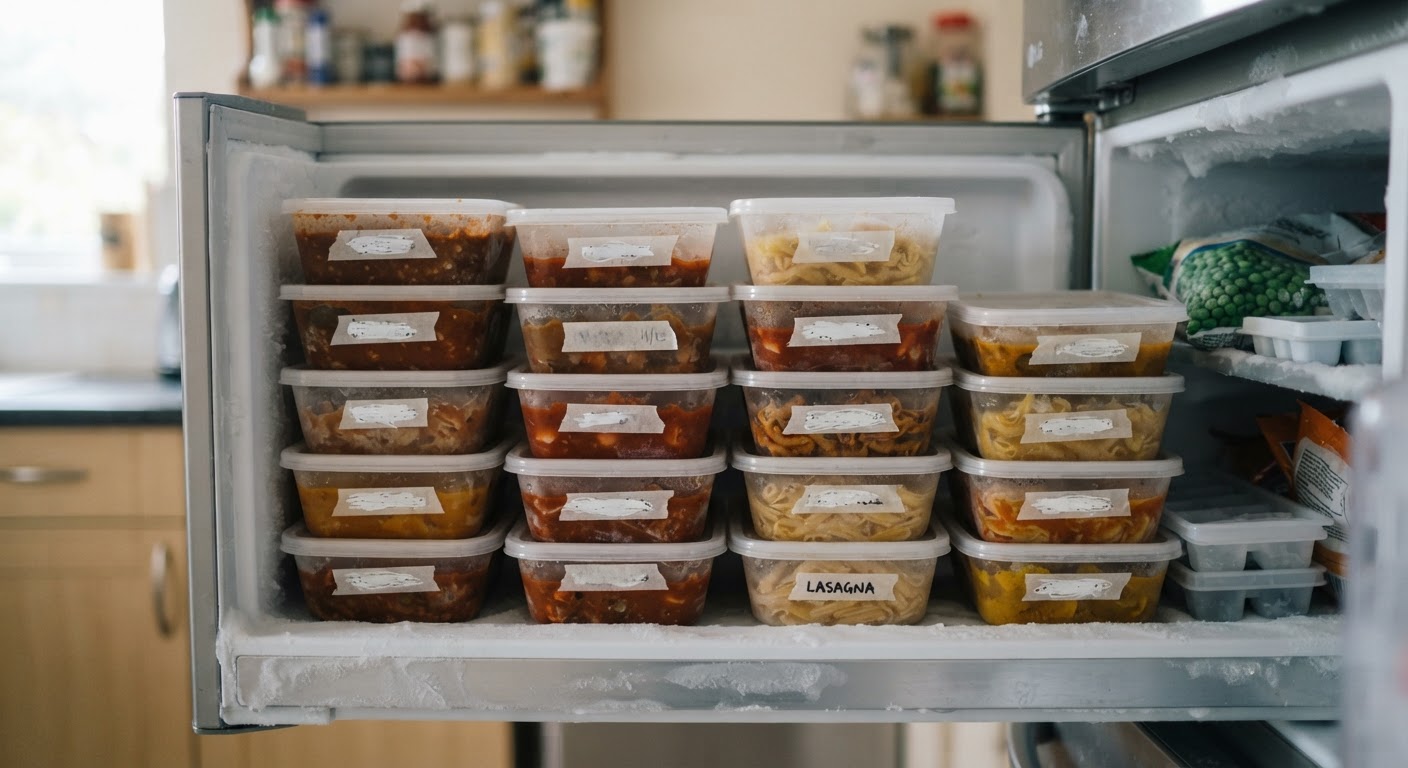
Label every single container with the recipe name and the date it was made. Use a permanent marker on freezer tape or a piece of masking tape — sticky notes fall off in the cold. Include reheating instructions if the method isn’t obvious, especially if different family members will be the ones pulling dinner together on a given night. “Chicken curry — 3/14 — thaw overnight, reheat covered, add splash of water” takes ten seconds to write and saves confusion later.
Freeze things flat when you can. Gallon freezer bags laid flat on a baking sheet until solid, then stacked upright like files, take up far less space than round containers and thaw faster too. This single habit is often what determines whether a household’s freezer can actually hold a full month of meals or runs out of room after two weeks.
Finally, put the oldest meals at the front and rotate new ones to the back, the same way you’d manage any pantry stock. A freezer that’s organized this way gets used in order, which means nothing lingers long enough to lose quality or get thrown out.
Comparing the real cost per meal to a fast-food or delivery night
It helps to actually sit down and do this math once, because the savings are usually bigger than people expect and seeing the real numbers is what keeps a household committed to doing this every month instead of only once.
Add up your total grocery spend for the marathon — proteins, produce, pantry staples, everything. Divide that by the total number of meal portions you ended up with. A session that costs a certain amount and produces, say, twenty-four dinner portions gives you a per-meal cost that, for most households doing this with recipes like chili, casseroles, and soups, comes out well below what a single fast-food order for a family typically runs, and nowhere close to what a delivery order with fees and tip adds up to.
The comparison gets even more favorable when you factor in what a rushed weeknight actually costs beyond the meal itself — the extra stop at the store for one missing ingredient, the “just this once” delivery order because everyone’s exhausted, the snacks bought to hold kids over while dinner gets figured out. A freezer full of ready meals removes the decision fatigue that leads to those extra spends. It’s not just that the meal itself is cheaper; it’s that having it ready removes the moments where impulse spending usually sneaks in.
Try tracking this for one month. Write down every night you would have ordered out or made a last-minute store run, and instead pull a freezer meal. At the end of the month, look at what you didn’t spend. For a lot of households, that single comparison is what turns this from an occasional experiment into a permanent monthly habit.
Building a rotating freezer inventory list so nothing goes to waste
The last piece, and the one people skip most often, is keeping an actual list of what’s in the freezer. Without it, meals get buried, forgotten, and eventually tossed — which erases a chunk of the savings you just worked to build.
Keep a simple sheet of paper on the freezer door or a note on your phone. Every time you add a batch of meals, write down what it is, how many portions, and the date. Every time you pull one out, cross it off. This takes thirty seconds and turns your freezer from a black box into something you can actually plan around.
Use this list when you’re deciding what to cook at your next marathon. If you’ve still got six portions of chili left but you’re out of casserole, that tells you exactly what to prioritize next time, so you’re not overproducing one dish while running out of variety in others.
It also helps on the nights when nobody has the energy to think. Instead of standing in front of an open freezer trying to guess what’s under the frost, you glance at the list, grab what’s oldest, and you’re done. That small bit of organization is really what makes the whole system sustainable — not the cooking itself, which most people can manage for one afternoon a month, but the follow-through that makes sure every dollar spent on that session actually turns into a dinner on the table instead of a bag of freezer-burned mystery food six months from now.