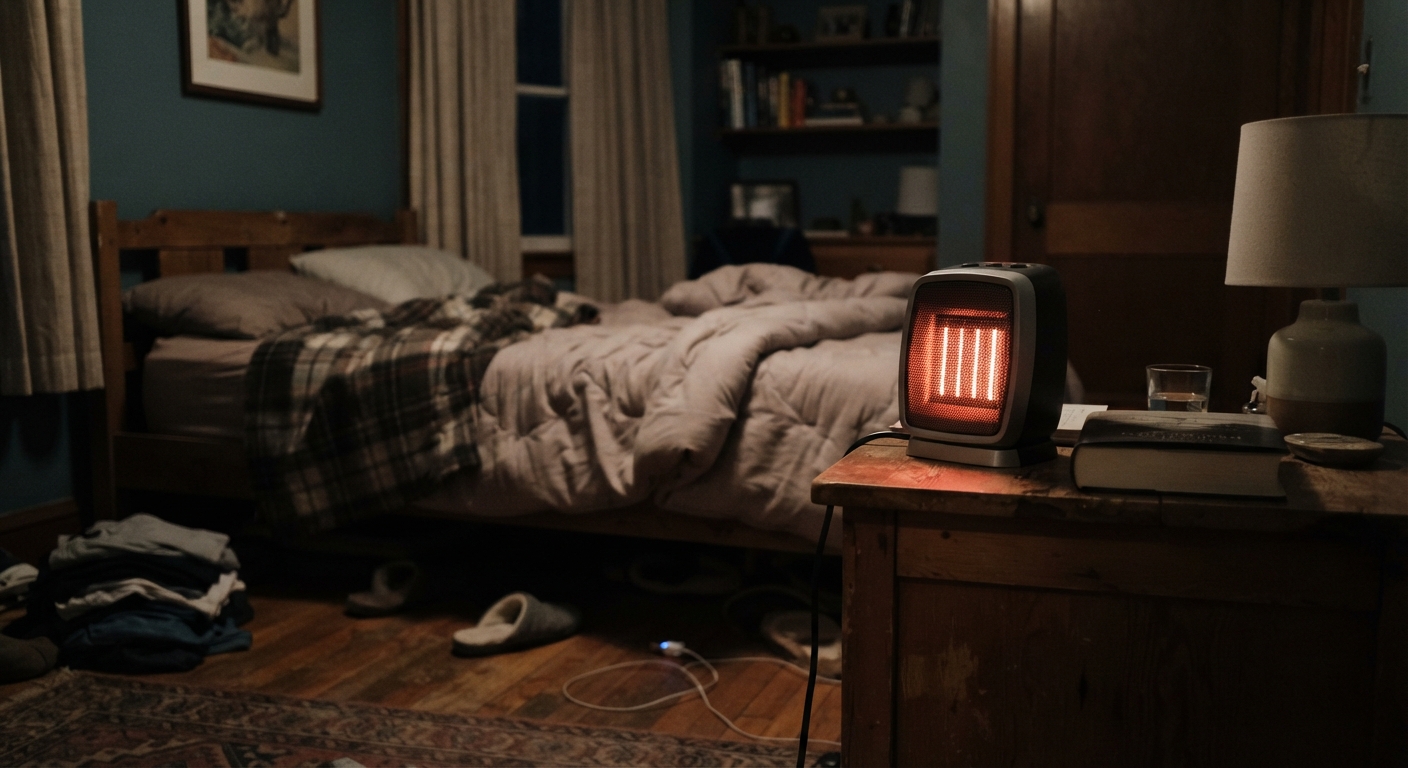
How to calculate the wattage cost of a space heater per hour versus raising your thermostat a few degrees
Every space heater has its wattage printed right on the box or the unit itself, usually somewhere between 750 and 1,500 watts. That number is the key to figuring out whether it’s actually saving you money, so it’s worth doing the math once instead of just guessing.
Here’s the simple version: take the wattage, divide by 1,000 to get kilowatts, then multiply by your electricity rate per kilowatt-hour. A 1,500-watt heater running for one hour uses 1.5 kilowatt-hours. If your rate is around 15 cents per kilowatt-hour, that’s about 22 cents an hour. Run it for six hours overnight and you’re looking at roughly $1.35. Check your utility bill for your actual rate — it’s usually listed as “kWh” somewhere on the statement — because rates vary a lot by region and by season.
Now compare that to your furnace. This is harder to pin down exactly because furnaces don’t run constantly — they cycle on and off to maintain a set temperature — but the general rule holds up in most homes: every degree you raise your thermostat increases your whole-house heating cost by a noticeable percentage, often cited as somewhere around 1-3% per degree depending on your climate, insulation, and system efficiency. If you’re heating an entire house to keep one bedroom comfortable, you’re paying that percentage increase on every room, including ones nobody’s sitting in.
The way to think about it isn’t “space heater versus furnace” in the abstract — it’s “cost to heat one room with a space heater” versus “cost to heat the entire house by a few degrees so that one room feels the same.” Once you frame it that way, the answer usually depends on how big your house is and how many rooms you’re heating unnecessarily.
Which rooms and situations actually make a space heater cheaper
Space heaters win when you’re heating a small, enclosed space and nobody else in the house needs that warmth. A few situations where the math almost always favors the space heater:
Bedrooms at night. If your household drops the thermostat overnight (a smart move on its own) but one person runs cold, a space heater in that bedroom with the door closed is far cheaper than nudging the whole-house temperature up for one person under a blanket.
Home offices or workspaces. If you’re the only one home during the day and working from a spare room, heating that single room instead of the whole house can cut your daytime heating cost significantly, especially in a larger home where the rest of the square footage sits empty.
One occupied room in the evening. Families that spend most of their evening in one living room or den, with bedrooms and other rooms unused until bedtime, can sometimes lower the thermostat a few degrees for the house and let a space heater carry that one room.
Space heaters lose the math when the space isn’t well sealed. A drafty room with an old window, a door that doesn’t close tightly, or high ceilings will bleed heat out as fast as the heater puts it in, and you’ll end up running it longer and hotter to compensate. Before relying on one, it’s worth doing a quick check — feel around window frames and door edges for cold air leaking in, and consider a draft stopper or removable weatherstripping if you find gaps. A ten-dollar draft snake under a door can make a bigger difference to your space heater’s efficiency than upgrading to a pricier model.
It’s also worth being honest about square footage. Space heaters are built for rooms in the 150-300 square foot range. Try to heat a large open-concept living area with one, and you’ll be running it at max output for hours, which erases any savings.
The safety and insurance reasons some space heaters cost you more than they save
This is the part that doesn’t show up in the wattage math but matters just as much. Space heaters are one of the most common causes of home heating fires, and that risk isn’t just personal — it can affect your finances directly if you’re a renter with a renters insurance policy.
Most renters insurance policies don’t ban space heaters outright, but they do care about how you use them. Leaving one running unattended, placing it too close to curtains, bedding, or furniture, or using an older unit without an automatic shutoff feature are the kinds of things that can turn a small mistake into a claim — and claims can affect your premium at renewal, even when the loss itself was covered. It’s worth a few minutes to reread the fire or personal property section of your policy, or call your agent and ask directly whether they have any guidance on space heater use, before you make one a nightly habit.
The practical fixes are cheap and take no real effort once they’re habits:
Keep at least three feet of clearance from anything flammable, including bedding and curtains. Never run one on a timer overnight in a bedroom while everyone’s asleep unless it has a tip-over shutoff and overheat protection — both are standard on any decent modern unit but worth confirming before you buy. Plug it directly into a wall outlet rather than an extension cord or power strip, since heaters draw enough current to overheat cheaper cords. And never leave one running in a room with nobody in it “to get ahead” of the cold — that’s the scenario that erases both the safety and cost argument in one move.
None of this means avoid space heaters. It means the heater’s true cost includes the cost of using it carelessly, and that cost can be a lot higher than a few cents an hour on your electric bill.
Ceramic vs oil-filled vs infrared: which type sips the least electricity
All space heaters of a given wattage use roughly the same amount of electricity — a 1,500-watt heater draws 1,500 watts whether it’s ceramic, oil-filled, or infrared. The real difference between types isn’t how much power they pull, it’s how efficiently they turn that power into warmth you actually feel, and how long they hold that warmth once they cycle off. That’s where your real savings come from.
Ceramic heaters
These heat up fast and push warm air out with a small fan, which makes them good for quickly taking the chill off a room you just walked into. The tradeoff is that they cool down just as fast once they’re off, so they tend to cycle on and off more often to maintain a temperature, which adds up over a long evening.
Oil-filled heaters
These take longer to warm up but hold heat much longer after they shut off, because the oil inside stays hot and keeps radiating warmth. For a room where you’re settled for hours — a bedroom overnight or an office during a full workday — an oil-filled heater often ends up cycling less often than a ceramic one, which can mean lower total run time and lower total cost for the same comfort level.
Infrared heaters
These heat objects and people directly in their line of sight rather than warming the air in the room, which makes them very efficient if you’re sitting close to one — at a desk, in a reading chair, at a table. They’re less effective at making an entire room feel warm, so they’re best suited to “I just need to be warm right here” situations rather than heating a whole bedroom evenly.
If you had to pick one type for the widest range of household situations, oil-filled heaters tend to offer the best balance of low ongoing cost and steady comfort for rooms you occupy for long stretches, while infrared heaters are the cheapest option for a single person parked at a desk or in a chair for a few hours. Ceramic heaters are best reserved for quick top-ups in rooms you’re only in briefly.
A simple weekly routine for using a space heater to lower your overall furnace runtime
The households that actually save money with a space heater aren’t the ones who just add it on top of their normal heating habits — they’re the ones who use it to justify turning the furnace down. Here’s a routine that works well for most families:
Pick your thermostat’s baseline temperature and lower it by three to five degrees for the hours your household is concentrated in one or two rooms — typically evenings and overnight. Set that as your new normal on the thermostat, using a schedule feature if your thermostat has one, so you’re not manually adjusting it every day.
Use the space heater to cover the gap in the rooms that are actually occupied during those hours: the living room in the evening, the bedroom overnight, the office during the workday. Turn it off the moment you leave the room — this is the habit that makes or breaks the savings, since a heater left running in an empty room is pure cost with no benefit.
Once a week, check in on the math. Look at your thermostat’s schedule and ask whether you can push the setback a degree further now that the space heater is doing more of the work. Small, gradual reductions in the furnace’s baseline temperature tend to go unnoticed by the household, while a sudden five-degree drop feels obvious and uncomfortable. Shaving it down half a degree at a time over a few weeks usually gets you further than one big change.
Also do a monthly check on your actual electric and gas usage if your utility provides it — many utility websites show a usage graph or comparison to the prior month. If your electric usage is climbing but your gas or heating usage isn’t dropping to match, that’s a sign the space heater is being used as an addition rather than a substitute, and it’s worth revisiting the routine.
Used this way, a space heater isn’t a separate expense sitting on top of your heating bill — it’s a tool for shrinking the amount of house your furnace has to warm at any given time. That’s really the whole strategy: heat the people, not the empty rooms, and let the thermostat follow.