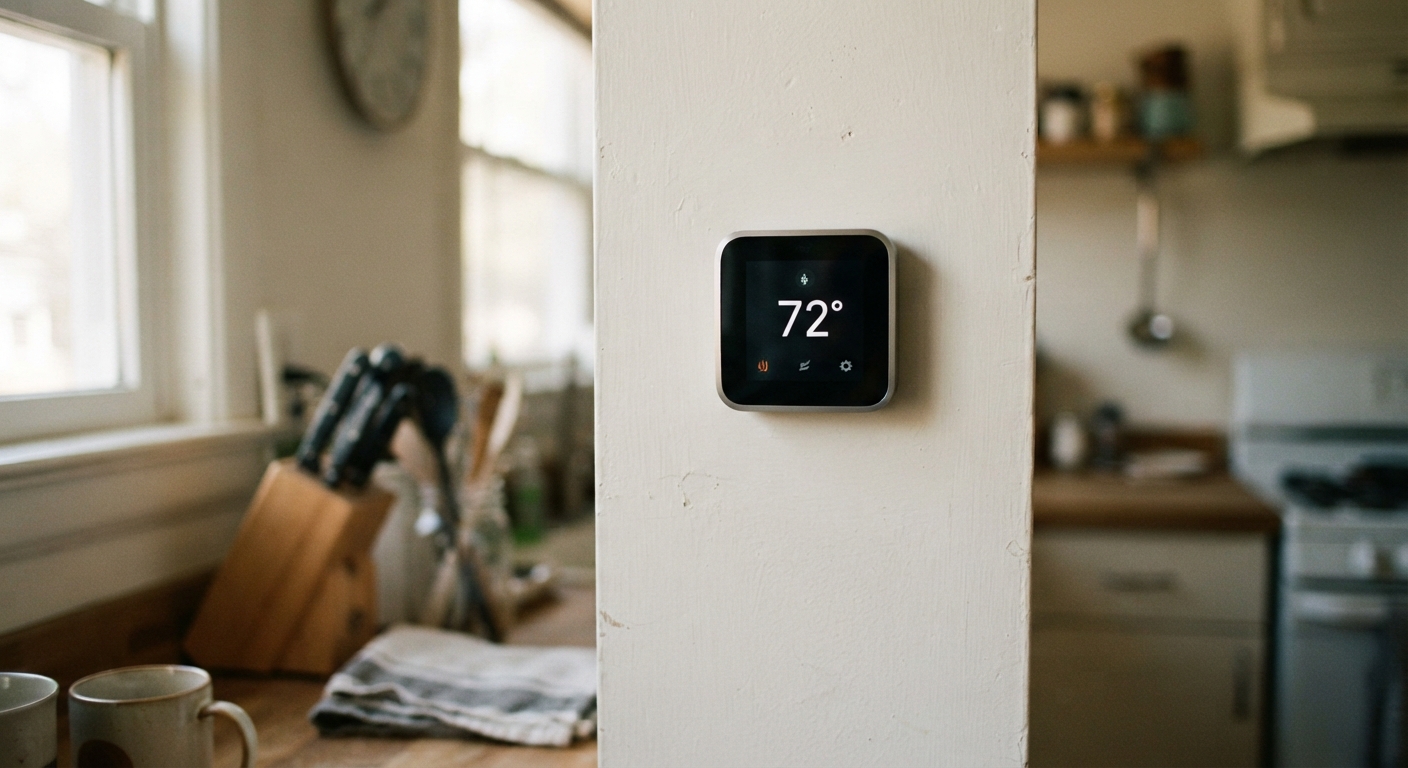
What smart thermostats actually save versus a programmable one you already own
Here’s the thing nobody tells you in the store: if you already have a programmable thermostat and you actually use it, a smart thermostat’s savings shrink fast. The big energy gains from smart thermostats come from fixing a specific problem — people who never programmed their old thermostat, or who had a simple manual dial and just left it running at one temperature all day whether anyone was home or not. If that’s you, switching to a smart model can genuinely cut your heating and cooling costs by a noticeable chunk, because the thermostat is now doing the thing you weren’t doing: backing off the temperature when the house is empty or everyone’s asleep.
But if you’re the type who already sets a schedule — cooler at night, warmer when someone’s home, backed off during work hours — a lot of that savings is already banked. What a smart thermostat adds on top is smaller stuff: it learns your patterns instead of you setting them, it can respond to actual weather instead of a fixed schedule, and it lets you adjust from your phone so you’re not running the AC for six empty hours because you forgot to change the schedule before a trip. Those are real, but they’re incremental, not transformative.
The other variable is your house itself. A smart thermostat can’t fix a drafty window, thin insulation, or a furnace that’s aging out. If your energy bills are high because the house leaks heat, no thermostat — smart or not — is going to solve that. It’ll just manage the leak slightly better. So before you assume a smart thermostat is your fix, it’s worth asking honestly: is the problem that nobody’s adjusting the temperature, or is the problem that the house doesn’t hold temperature well in the first place? Those need different fixes, and only one of them is solved by a $100–$250 gadget.
How to estimate your household’s break-even point using your own energy bills
Skip the manufacturer’s savings estimate — it’s built on an average household that may not look anything like yours. You can build a much more honest number using your own bills, and it only takes a few minutes.
Start by pulling your last twelve months of energy bills, or as many as you have. Separate out the months where heating or cooling was doing most of the work — for most climates that’s going to be a stretch of winter months and a stretch of summer months, with some mild shoulder months in between where your bill barely moves no matter what the thermostat’s doing. Those shoulder months matter because they show you your baseline — the part of your bill that has nothing to do with heating or cooling at all, and therefore nothing a thermostat can touch.
Once you know your baseline, look at how much higher your bill climbs in your peak heating and peak cooling months. That difference — the amount above baseline — is the portion of your bill that a thermostat could theoretically influence. A realistic assumption for someone who is not currently programming temperature setbacks at all is that a smart thermostat might shave a modest percentage off that heating/cooling portion, not off your whole bill. If you already program setbacks manually, cut that expected savings roughly in half, because you’re already capturing a good chunk of it.
Now do the math that actually matters: take your estimated annual dollar savings and divide it into the purchase price of the thermostat, plus any installation cost if you’re paying someone to put it in. That gives you your break-even point in years. If a thermostat costs around $150 installed and you estimate it’ll save you $40 a year, you’re looking at close to a four-year payback. If you estimate it’ll save $75 a year, you’re under two years. Neither of those numbers is wrong to act on — it depends on whether you plan to be in this home, with this system, for that long.
One more thing worth checking before you buy: how old is your current thermostat, and is it already doing scheduling well? If your current programmable thermostat is old enough that its schedule doesn’t actually match your life anymore — kids’ school hours changed, someone started working from home, you moved bedtime — reprogramming the thermostat you already own for free might close a good chunk of the gap before you spend anything at all.
Renter-specific considerations: installation, compatibility, and taking it with you when you move
If you rent, there are a few extra questions to answer before you buy, because the math changes when you don’t own the walls.
First, check your lease or ask your landlord about modifying the thermostat. Some landlords are fine with it, some want to install it themselves or approve the model first, and some HVAC systems in rental units — especially older buildings with boiler heat, window units, or shared systems — simply aren’t compatible with a smart thermostat at all. It’s worth a five-minute conversation before you buy something that ends up sitting in a drawer.
Second, think about compatibility with your actual system, not just your walls. Smart thermostats generally need a certain wiring setup to work, and older systems — particularly ones without a common wire — sometimes need an added part or a slightly different model to function properly. Most smart thermostat manufacturers have a simple compatibility checker online where you can enter what wires your current thermostat has, and it takes just a couple of minutes to find out whether your system will play nicely before you spend any money.
Third, and this is the one renters skip too often: can you take it with you when you move? Most smart thermostats are designed to be uninstalled and reinstalled, and the thermostat itself is yours to keep — but you’ll need to put the original, basic thermostat back on the wall before you leave, both to keep the unit rentable for the next tenant and to avoid any dispute over “unauthorized modifications” at move-out. That means holding onto the old thermostat instead of tossing it, and being comfortable doing a basic reinstall yourself, or budgeting a bit for someone to do it for you. If you move fairly often, factor that hassle into your payback math — a thermostat you install and reinstall three times over three apartments is still worth it if the dollar savings pencil out, but it’s more work than a homeowner’s version of the same purchase.
Finally, if you’re in a unit where you don’t control the heat or cooling source at all — central building heat, for example — none of this applies to you, and no amount of thermostat shopping will change your bill. In that case, your energy savings are going to come from other places, not this purchase.
Free or discounted smart thermostat programs some utilities still offer
Before you pay full price, it’s worth checking whether your utility provider offers any kind of rebate or discount program for smart thermostats. A meaningful number of electric and gas utilities run these programs because a thermostat that reduces peak-hour demand actually saves the utility money too, so they’re often willing to subsidize part of the cost to get more of them installed in homes on their grid.
These programs vary a lot by provider and change over time, so the way to find out is simple: log into your utility account online or call the number on your bill and ask directly whether they have a smart thermostat rebate, discount, or free-installation program currently running. Some utilities will mail you a thermostat at no cost in exchange for letting them make small, infrequent adjustments to your temperature during periods of high grid demand — usually just a degree or two, for a limited window, and usually something you can opt out of for any given day if you need to. Others offer a straightforward rebate you claim after purchase, which effectively lowers your break-even point by shrinking the upfront cost.
It’s also worth checking whether your state or local government runs any energy-efficiency assistance programs that include thermostats as part of a broader home weatherization effort — these are sometimes bundled with other small upgrades like weatherstripping or LED bulbs. Availability and rules differ enough by location that it’s not something to guess at; a quick call to your utility or a look at their website’s “rebates and programs” section is the fastest way to know what’s actually on the table for you right now.
When skipping the smart thermostat and just changing habits saves you the same money
Here’s the honest version of this article’s ending: for a lot of households, the savings a smart thermostat promises are savings you can get for free, just with a little more discipline.
If your current thermostat is programmable and you simply haven’t set it up, spend fifteen minutes doing that before you spend any money. Set it back a reasonable amount while you’re asleep and while the house is empty during the day, and set it to recover before people are actually home or awake. That single change captures most of the savings a smart thermostat would otherwise be selling you.
If your thermostat is a basic manual dial with no scheduling at all, the habit version of this is just remembering to adjust it yourself — turning it down before bed and before you leave for work, and back up shortly before you return. It’s less convenient than a device that does it automatically, and it’s easy to forget on a hectic morning, which is exactly the inconvenience you’re paying a smart thermostat to remove. But if money is tighter than time right now, it’s a real substitute, not a lesser one — the furnace or AC doesn’t know or care whether a human or an algorithm told it to back off.
Other no-cost habits stack on top of either option: closing curtains during the hottest part of summer afternoons, using ceiling or portable fans to feel a couple degrees cooler without lowering the actual temperature, sealing obvious drafts around doors and windows with cheap weatherstripping, and layering up or using a blanket in winter before reaching for the thermostat dial. None of these require buying anything close to $150, and combined, they often close a meaningful part of the gap between “doing nothing” and “buying the smart version.”
The smart thermostat isn’t a bad purchase — for the right household, in the right climate, with the right existing habits, it pays for itself and then keeps saving money for years after. But it’s a tool for convenience and consistency, not a magic multiplier. If you’re confident you’ll actually use the manual scheduling and remember to adjust it, you may be paying for a feature you’re capable of replicating yourself. If you know yourself well enough to know that convenience is the only thing that actually gets it done in your house, that’s a legitimate reason to spend the money — just go in knowing your real break-even number instead of the one on the box.