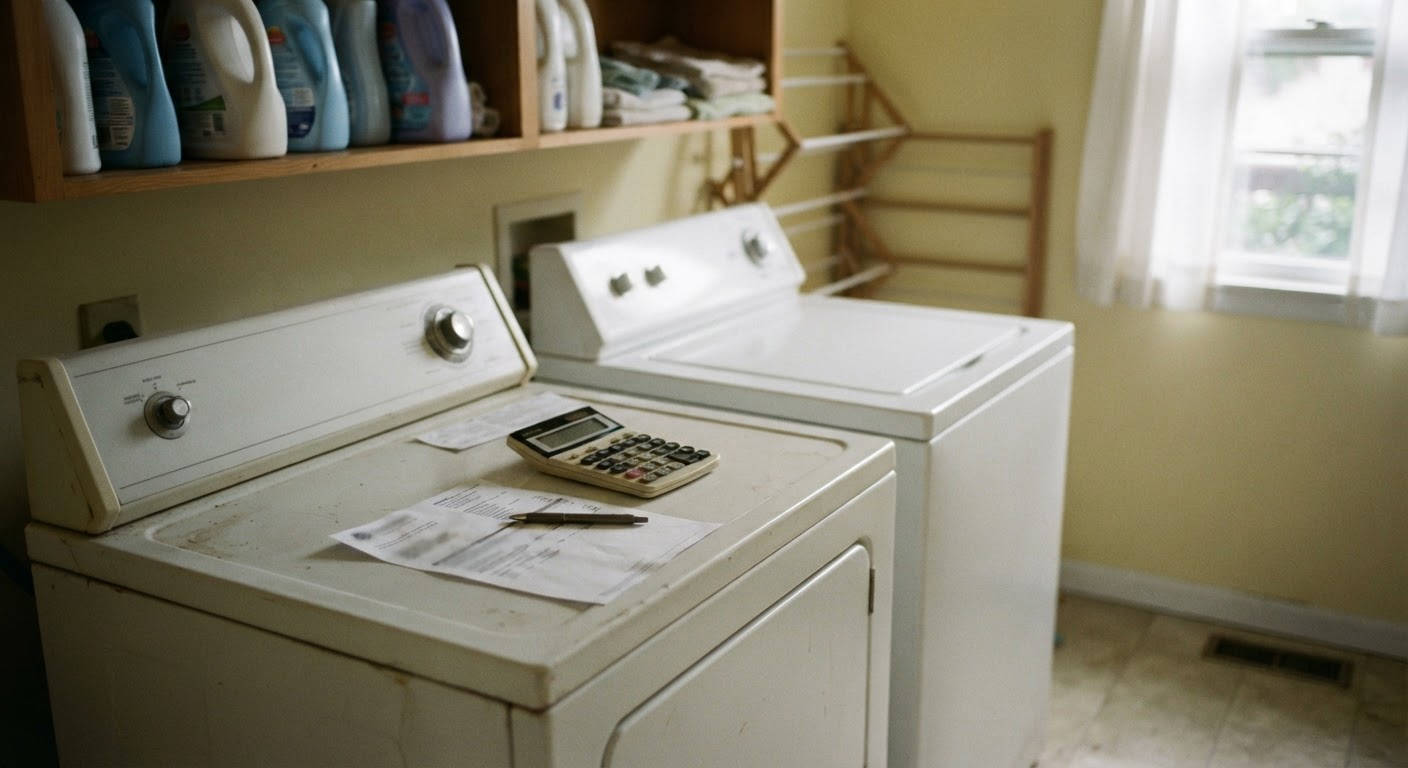
How utility companies price a load of laundry differently depending on fuel type
Gas and electricity aren’t priced the same way, and that’s the root of almost every dryer cost question. Electricity is billed by the kilowatt-hour, and a standard electric dryer pulls a lot of power for the 40 to 60 minutes it runs. Gas is billed by the therm (or sometimes CCF, which is close enough for our purposes), and a gas dryer uses a small burner to do most of the heating work while a much smaller electric motor just tumbles the drum and runs the control panel.
That difference in how the heat gets generated is why gas dryers are almost always cheaper to run per load, even in places where gas prices have crept up. You’re not paying to generate heat with electric resistance, which is one of the least efficient ways to make heat there is. You’re paying gas company rates for combustion, plus a small trickle of electricity for the motor and electronics.
This is also why your specific rates matter more than any national number you’ll read online. Utility pricing is regional, seasonal, and sometimes even tied to your specific plan or provider. Two households a few miles apart can have meaningfully different electric rates per kWh, and gas rates swing with the season in a lot of markets, cheaper in summer, pricier in winter when heating demand competes for the same supply. If you want an honest answer for your own household, the fastest way is to look at your actual utility bill rate per kWh and per therm rather than trusting a number from an article that was written somewhere else.
Average per-load cost comparison using national gas and electric rates
Without pretending to hand you a precise national figure, here’s the shape of the comparison that holds true almost everywhere: a load in an electric dryer typically costs somewhere in the range of three to four times more than the same load in a gas dryer, for the exact same clothes, the exact same cycle length, and the exact same dryer age.
To make that concrete without inventing numbers that don’t apply to your area, try this exercise with your own bill. Find your rate per kWh for electricity and your rate per therm for gas. A typical electric dryer draws somewhere around 3,000 to 5,000 watts while running, which is 3 to 5 kWh per hour. A typical gas dryer’s electric draw, by contrast, is usually under 500 watts, since it’s only running the drum motor and igniter, not generating heat electrically. Multiply your own kWh rate by the hourly draw and you’ll get a rough cost-per-hour for each fuel type. Do that math side by side and the gap usually isn’t subtle.
Where this gets interesting for a monthly household budget: laundry adds up faster than people expect. A family running five to seven loads a week isn’t dealing with a one-time cost, it’s a weekly recurring line item that compounds over a year. If you’re currently on electric and doing that volume of laundry, the difference between fuel types can be one of the larger “hidden” costs in a monthly utility bill, right up there with heating and cooling.
One caveat worth saying plainly: if you’re on a laundromat card system or a submetered apartment laundry room, none of this math applies to you directly, since you’re paying a flat per-load or per-minute rate regardless of the appliance’s actual fuel source. This section is really about the difference for people with an in-unit dryer they either own or are considering installing.
Hidden costs: venting, installation, and adapter kits landlords won’t always cover
This is the part that trips up most renters, and it’s where “switching would save me money” quietly turns into “switching cost me more than I saved.” A dryer swap is never just the appliance.
Gas dryers need a gas line and, in most cases, professional installation, since you’re dealing with a live gas connection rather than just an outlet. If your unit doesn’t already have a gas line run to the laundry space, running one is a real project involving a licensed technician, and it’s not something most renters are able to do themselves or get approved for on a lease. Even if the line exists, older units sometimes need a shutoff valve replaced or a flexible connector swapped for safety code reasons, which is a small cost but a real one.
Electric dryers have their own quiet cost trap: the outlet. Many electric dryers need a 240-volt outlet with a specific plug configuration, and older buildings sometimes only have the 3-prong version when your dryer comes with a 4-prong cord, or vice versa. An adapter cord is cheap, generally under the cost of a nice dinner out, but if the wiring itself needs upgrading to support a 240-volt circuit at all, that’s an electrician job, not a weekend fix.
Then there’s venting, which people underestimate constantly. Both gas and electric dryers typically need to exhaust somewhere, and if you’re moving a dryer into a space that never had one, or swapping between fuel types in a way that changes the vent path, you may need new ducting, a new exterior vent cap, or rerouting around a wall that wasn’t built with a laundry appliance in mind. Vent length and layout also affect drying time and safety, so this isn’t a corner worth cutting even when it’s tempting.
Before you assume any of this is your landlord’s responsibility, check your lease and ask directly. Landlords vary widely here. Some will cover gas line work because it’s a permanent property improvement that benefits the unit long-term. Others will tell you outright that appliance swaps and their associated installation costs are on the tenant, especially if the change isn’t required for the unit to function, just preferred. Get this in writing before you spend anything, because a verbal “sure, that’s fine” from a landlord doesn’t help you if the story changes later.
When a portable or ventless dryer changes the math entirely
If your rental has no gas hookup, no dryer vent access at all, or a landlord who’s clearly not interested in any installation work, a full fuel-type swap might not be realistic no matter how good the per-load savings look on paper. This is where ventless and portable dryers earn a second look.
Ventless electric dryers, usually heat-pump or condenser style, don’t need any duct to the outside. They pull moisture out of the air inside the drum and either collect it in a removable tank you empty after each load or drain it through a standard household drain line. That means no vent installation, no exterior cap, and no coordination with a landlord about cutting a hole in a wall. They run on standard household electric circuits, sometimes even a regular 120-volt outlet depending on the model, which sidesteps the 240-volt wiring question entirely.
The tradeoff is real and worth naming honestly: heat-pump and condenser dryers generally run longer cycles than a standard vented dryer, sometimes noticeably longer, and the upfront purchase price tends to run higher than a comparable vented electric model. What you’re buying with that extra time and expense is flexibility, the ability to have a dryer in a space that could never otherwise support one, without needing your landlord’s cooperation or a construction project.
For someone weighing gas versus electric purely on a monthly operating cost, a ventless unit usually won’t beat a properly installed gas dryer on a pure cost-per-load basis. But for someone whose actual constraint is “I’m not allowed to modify this unit” or “there’s no vent access, period,” the comparison isn’t really gas versus electric anymore, it’s ventless versus no dryer at all, or ventless versus the ongoing cost and hassle of a laundromat. Framed that way, the math often flips in favor of the ventless option, even with its higher per-load running cost.
A simple way to calculate your own break-even point before buying anything
Before you buy or swap anything, it’s worth running a break-even number specific to your household, because the “it pays off eventually” advice you see online almost never accounts for your actual laundry volume or your actual installation costs.
Start with your estimated savings per load, using your own utility rates from the earlier section rather than a generic number. Multiply that per-load savings by how many loads your household actually runs in a typical week, then multiply by 52 to get an annual savings figure. That’s your top-line benefit.
Next, add up every real cost of the switch: the appliance itself if you’re buying new, delivery and haul-away of the old unit, any electrician or plumber work for the outlet or gas line, venting changes, adapter kits, and anything your landlord has confirmed in writing they won’t cover. Don’t leave out small items like a new dryer cord, since those weren’t automatically included even a few years ago and often aren’t included now either.
Divide your total switching cost by your annual savings figure, and that gives you the number of years until the switch pays for itself. If you’re renting, hold that number up against how long you realistically expect to stay in the unit. A break-even point of a year and a half means a lot if you’re settled somewhere for the next five years, and means very little if your lease is up in eight months and you don’t know where you’re headed next.
If the math comes back close, tilt toward the option with lower upfront disruption rather than the option with the theoretically better long-term number. A move that saves you money on paper but requires landlord negotiation, contractor scheduling, and weeks of laundromat trips in the meantime isn’t automatically the better trade for a household running on a tight monthly budget. Sometimes the version of “savings” that actually shows up in your bank account is the smaller, simpler one you can start this month instead of the bigger one that depends on everything going smoothly first.