When your summer electric bill jumps, the first instinct is to blame the thermostat. But the real question is simpler than most people realize: are you paying to cool square footage nobody’s standing in? If you spend most evenings in one bedroom, one home office, or one nursery, running the whole central system to chill hallways, closets, and a guest room can cost more than just cooling the room you’re actually in. Here’s how to figure out which approach actually saves you money, based on your specific setup rather than a rule of thumb.
Why central air conditions rooms you’re not using, and what that costs per hour
Central air doesn’t know where you are in the house. It’s designed to bring the whole structure to one target temperature, which means every square foot gets treated the same whether someone’s in it or not. That closed-off guest room, the hallway, the kitchen you left an hour ago — all of it is pulling cold air and losing it right back out through doors, vents, and poorly insulated walls.
Think about what fraction of your home’s square footage you’re actually occupying after dinner. For a lot of households, it’s one bedroom and maybe a bathroom — sometimes less than a quarter of the total floor space. Central air doesn’t have a way to scale down proportionally. It runs the compressor, pushes air through the same ductwork, and conditions the same volume of space whether one person is home or six.
That’s the core inefficiency worth paying attention to: you’re not just paying for comfort, you’re paying to condition unused volume. The bigger the gap between your home’s total square footage and the space you actually use in the evening, the more likely a single-room cooling strategy will save you money.
Comparing wattage and BTU ratings between window units, portable ACs, and central systems
To compare costs fairly, you need two numbers for each cooling option: the BTU rating (how much heat it can remove) and the wattage draw (how much electricity it uses to do that). Manufacturers print both on the unit’s spec sticker or in the manual, usually as “cooling capacity” and “power input” or “amps.”
Window units for a single bedroom typically fall in a modest BTU range designed for a few hundred square feet, and their wattage draw tends to be efficient because the unit only has to move air through a small opening and cool a contained space. Portable units marketed for the same size room usually carry a similar BTU rating but draw more watts to produce it, because they lose efficiency venting hot air through a flexible hose to a window kit, and the compressor and fan both sit inside the room they’re cooling, adding some of their own heat back into the mix.
Central air systems are rated in tons rather than BTUs on the sticker, but the conversion is straightforward — each ton equals a large multiple of the BTUs a window unit handles. A central system sized for an entire house is, unsurprisingly, doing an enormous amount more work than a window unit, which is exactly why running it just to cool one occupied room is such a mismatch between tool and task.
The practical takeaway: check the yellow energy guide sticker or spec sheet for your specific window unit, portable unit, and central system model. You want the wattage number, not just the BTU number, because wattage is what actually shows up on your bill.
A simple formula to estimate your cost per hour for each cooling option
Once you have the wattage for each unit, the math is the same for all of them:
Watts ÷ 1000 × your utility’s price per kilowatt-hour = cost per hour of continuous running.
Say your window unit draws 900 watts and your electricity runs 15 cents per kilowatt-hour. That’s 0.9 kilowatts × $0.15, or about 13.5 cents an hour to run continuously. A portable unit rated for the same room but drawing 1,200 watts would run closer to 18 cents an hour under the same rate. Neither unit runs at full draw the entire time — the compressor cycles off once the room hits temperature — so real-world cost is usually lower than this ceiling number, but it’s a useful worst-case comparison point.
For central air, you’d use the same formula with the compressor’s rated wattage, which you can usually find on the outdoor unit’s nameplate or in the system manual. Multiply that hourly cost by however many hours it runs to maintain temperature across the whole house, not just the room you’re in.
The comparison that actually matters isn’t “window unit cost per hour” versus “central air cost per hour” in isolation — it’s “cost to cool one room with a window unit” versus “cost to cool the entire house with central air just so one room stays comfortable.” That second number is almost always bigger, because the central system is doing far more total work to deliver the same result for you personally.
When a single window unit in a bedroom or nursery beats running whole-house AC overnight
Overnight is where single-room cooling usually wins most clearly. If everyone in the house sleeps in bedrooms that are closed off anyway, there’s rarely a good reason to cool the living room, kitchen, and hallways for eight hours while they sit empty.
A window unit sized correctly for a bedroom, running through the night, is doing a small, contained job: cooling one enclosed space and holding it there. Central air doing the same overnight job is cooling the whole envelope of the house to reach that one bedroom’s target temperature, fighting heat gain through every exterior wall, window, and roof section along the way.
This is especially true for a nursery, where parents often want a lower, steady temperature overnight regardless of what the rest of the house needs. Rather than dropping the whole-house thermostat several degrees to get one room comfortable, a dedicated window or portable unit in that room lets you hit the target temperature you actually want without conditioning the rest of the house to match it.
The overnight math tends to favor single-room units for one more reason: central systems often have to work harder in the evening and early morning as the day’s heat is still radiating out of walls and roofing, while a window unit in one bedroom is only fighting the heat load of that one room’s walls and windows.
The insulation and door-sealing tricks that make single-room cooling actually work
Single-room cooling only pays off if the room actually holds the cold air. If the door doesn’t seal and there’s a gap under it, or if the window frame around your unit is leaky, you’re paying to cool air that drifts right back out into the hallway.
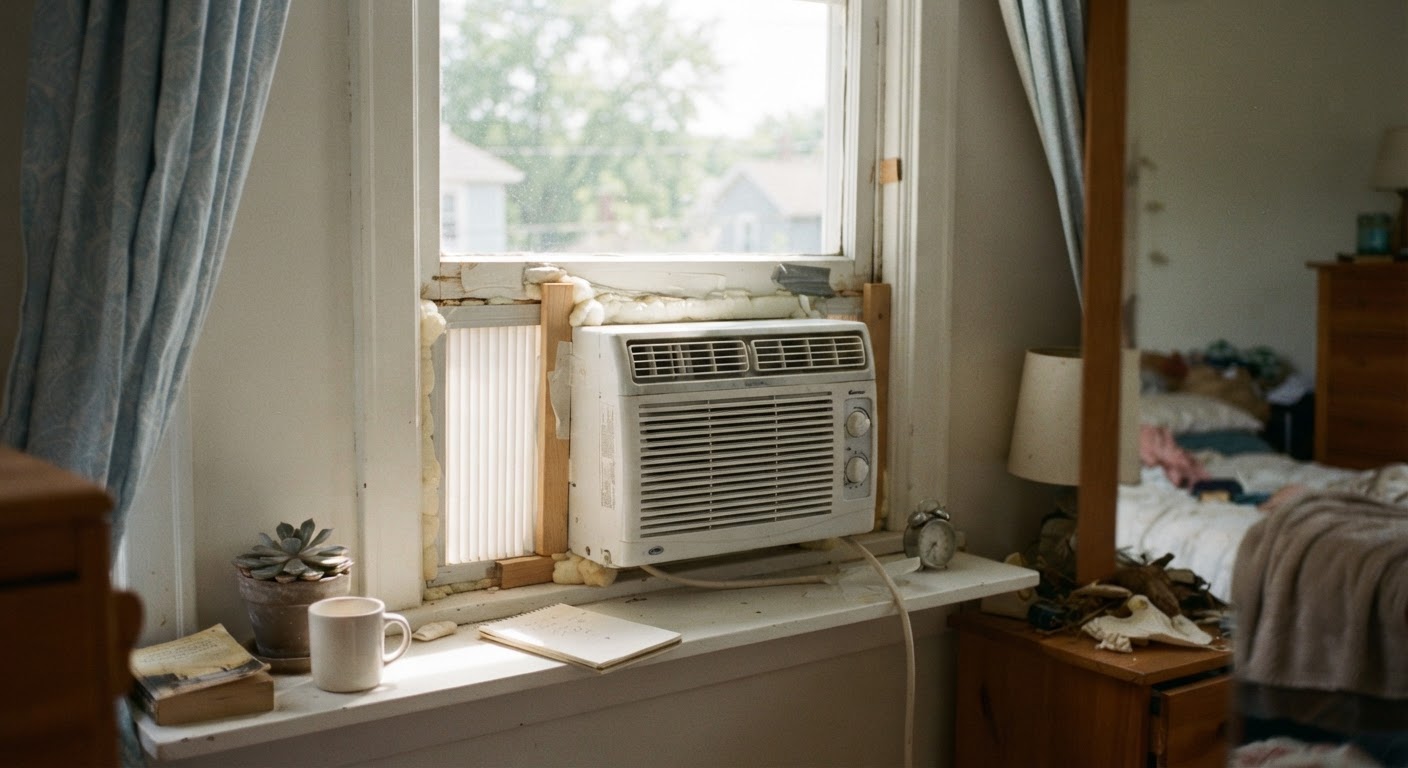
A few low-cost, low-effort fixes make a real difference here. A draft stopper or rolled towel at the bottom of the door keeps cold air from sliding out under it. Foam weatherstripping tape around the window unit’s frame, and the foam side-panel kit that usually comes with it, closes the gaps that let outside heat leak in around the unit itself. For portable units, make sure the exhaust hose connection to the window kit is actually sealed — a loose fit there is one of the most common reasons people feel like their portable AC “isn’t working,” when really it’s just venting cool air back out with the hot exhaust.
Closing blinds or curtains during the hottest part of the day cuts down on the heat the room absorbs before you even turn the unit on, which means less work for the unit once you do. And if the room has a return air vent from the central system, closing it can help keep that room’s cooled air from mixing back into ductwork that’s not actively running.
None of this requires a renovation. It’s mostly fifteen minutes and a roll of weatherstripping tape, and it’s the difference between a window unit that holds a room at a comfortable temperature efficiently and one that runs constantly trying to fight leaks.
Situations where central air still wins, like open floor plans or multiple occupied rooms
Single-room cooling isn’t the right call for every layout. If your home has an open floor plan where the kitchen, living room, and dining area all flow into one another without doors, there’s no way to contain cooled air to “just one room” — a window unit would be fighting an open space that’s constantly mixing with the rest of the house.
It also stops making sense once more than one or two rooms are occupied at the same time. If you’ve got kids in separate bedrooms, someone working from a home office, and shared time in the living room, you’d need multiple window or portable units running simultaneously to cover all of it — and at that point, the combined wattage of several small units can add up to more than what the central system would use to do the whole house at once.
Central air also tends to win in homes with poor insulation overall, since a leaky house makes single rooms harder to keep sealed off from the rest of the structure regardless of how well you weatherstrip one door. And if you’re already paying for central air as part of rent or a flat utility arrangement, running a portable or window unit on top of it just adds cost without removing any.
The honest way to think about it: single-room units are a tool for concentrated, predictable occupancy — one or two rooms, most of the time, most days. Once your household’s cooling needs spread out across the house, central air starts pulling its weight again.
How to combine a smart thermostat setback with a portable unit for the biggest savings
The biggest savings usually come from doing both at once rather than treating it as an either-or choice. Set your central thermostat several degrees warmer than you normally would during the hours you’re mostly in one room — enough to take the load off the compressor without letting the rest of the house get uncomfortably warm — and let a window or portable unit handle the room you’re actually occupying.
A smart or programmable thermostat makes this painless because you can schedule the setback automatically for the evening and overnight hours instead of remembering to adjust it manually. Many also let you set a “hold” temperature that’s easy to override for the rare day when you do need the whole house cooled evenly, like when you’re hosting people in multiple rooms.
This combination works because it attacks the cost from both directions: the central system uses less energy maintaining a warmer overall setpoint, and the single-room unit fills in the gap only where you need it, sealed and contained by the door and window tricks above. Neither one is doing the other’s job — they’re splitting the work so neither system has to run harder than it needs to.
Track your bill for a full month after making the switch before deciding it’s working. Cooling costs shift with outdoor temperature swings day to day, so a single hot week isn’t a reliable comparison. A monthly total, compared against a similar month last year or against your bill from before the change, gives you a much clear