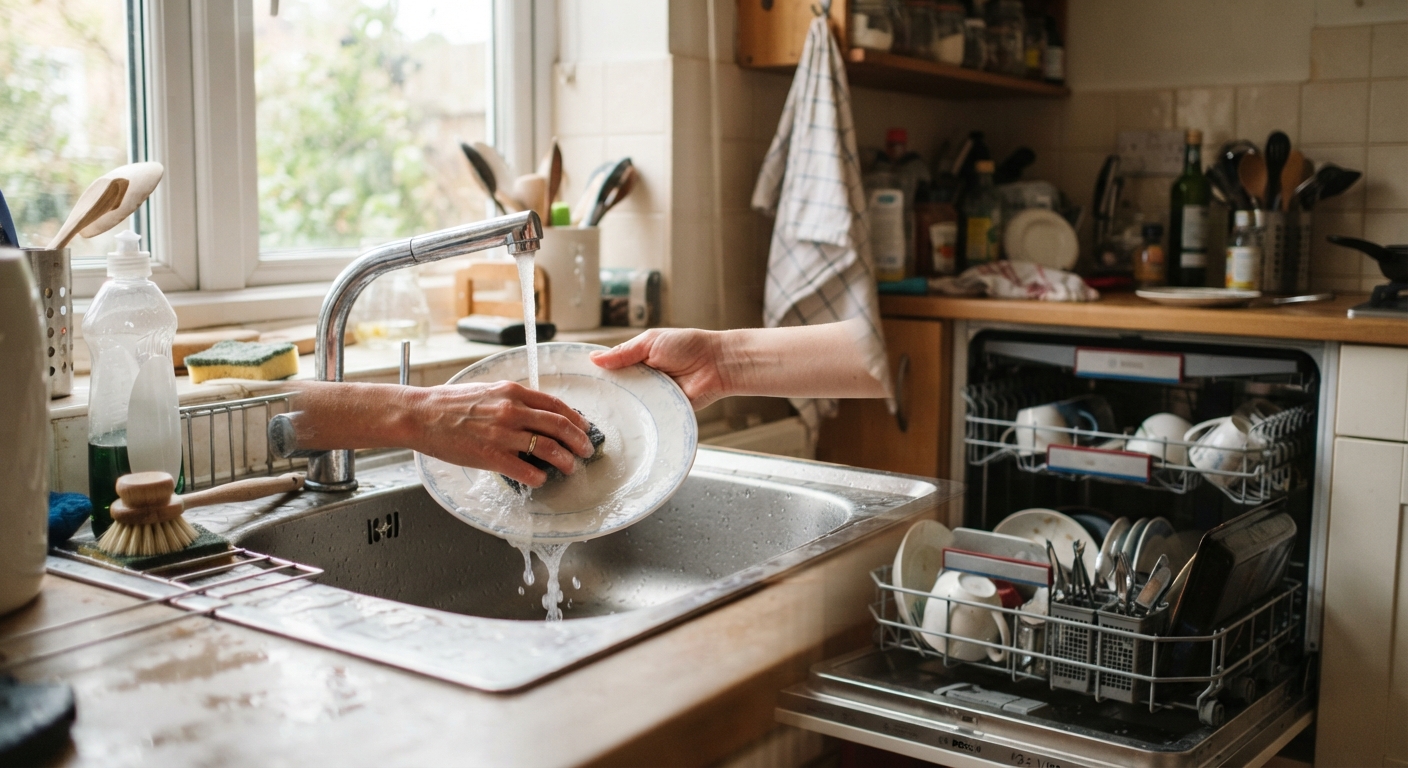
If you grew up watching a parent or grandparent hand-wash every dish, you probably absorbed a simple rule: the dishwasher is a luxury, and washing by hand is what frugal, careful people do. That belief made sense decades ago, when dishwashers were genuinely water-hungry machines that sprayed and rinsed with little regard for efficiency. Older models could burn through fifteen gallons of hot water or more per cycle, and appliances back then didn’t have soil sensors, targeted spray arms, or smart cycle lengths. In that era, hand-washing really could be the cheaper option, especially if you were quick about it and didn’t let the tap run.
The myth stuck around because it lines up with a few other things that feel true. Hand-washing feels more “active” and controlled, so it seems like it must use less. Dishwashers also cost money upfront and use electricity in an obvious, humming way, while the tap running during hand-washing is quieter and easier to ignore. There’s also a generational habit loop: many of us learned dishwashing from someone who never had an efficient machine, so the advice got passed down without an asterisk saying “this was true for older models, not necessarily yours.”
Today’s efficient dishwashers have quietly flipped the math for a lot of households, and if you’re still hand-washing out of a belief that it’s the frugal choice, it’s worth checking whether that’s still accurate for your kitchen.
Average gallons used per load: modern efficient dishwasher vs. running the tap by hand
Here’s the comparison that surprises most people. A modern efficient dishwasher, the kind widely available now, typically uses somewhere in the range of three to four gallons of water for a full cycle. That’s for an entire load — plates, bowls, glasses, pots, utensils, all of it.
Hand-washing the same load, by contrast, tends to use far more water than people assume, mostly because of the running tap. If you wash dishes with the water running continuously while you scrub, rinse, and set items aside, you can easily use somewhere between eight and twenty-seven gallons for the same amount of dishes, depending on your faucet’s flow rate and how long the water runs. Even careful hand-washing, where you fill one basin for washing and another for rinsing, generally lands higher than a dishwasher’s per-load total, though the gap narrows considerably.
The reason the gap is so large is simple: a dishwasher sprays water in short, targeted bursts and reuses some of that water within a cycle, while a running faucet just keeps flowing the entire time you’re working, whether or not water is actually touching a dish at that exact second. Most of us don’t think about how many gallons pass through the faucet while we’re scrubbing a stuck-on bit of sauce or reaching for the next plate — but that idle flow adds up fast.
How water heating costs factor into the real total, not just gallons used
Gallons used is only half the story. The other half is how much it costs to heat that water, and this is where the comparison gets more interesting, because both methods typically use hot water.
Dishwashers usually heat at least part of their own water internally, and many models have a heating element that boosts water to a higher temperature than what comes out of your tap, since hot water is more effective at cutting grease and sanitizing. That heating uses electricity, but because the appliance uses so little total water, the energy cost per load tends to stay modest.
Hand-washing draws hot water straight from your water heater, and depending on your setup, that water traveled from a tank or tankless unit through your pipes to reach the faucet, losing some heat along the way. To compensate, most people run the tap hotter and longer than they realize, especially when tackling greasy pans. Since heating water is one of the more energy-intensive parts of a home water heating bill, and hand-washing typically uses more total gallons of hot water than a dishwasher cycle, the heating cost for hand-washing often ends up higher even though it feels like the more modest, low-tech option.
If your water heater runs on electricity or gas, this cost is easy to overlook because it doesn’t show up as its own line item — it’s blended into your overall utility bill. But it’s very real, and it’s the piece that tips the scales in the dishwasher’s favor in a lot of households.
The tipping point: how many place settings per load changes the math
None of this means a dishwasher automatically wins in every kitchen. The real answer depends heavily on how full your dishwasher gets before you run it, because a dishwasher run half-empty is not actually more efficient than hand-washing that same smaller pile of dishes.
Dishwashers are designed around the assumption of a full or nearly full load. If you’re running one for a handful of items — say, after a quick breakfast for two — you’re using the same three to four gallons and the same energy to heat that water, but spreading it over far fewer dishes. In that scenario, hand-washing a small number of items in a basin, without the tap running the whole time, can easily be the cheaper option.
The tipping point tends to show up somewhere around a moderate-to-full load, roughly when you’ve got enough dishes to fill most of the racks — think a family dinner’s worth of plates, bowls, cups, and cooking pans, rather than a couple of coffee mugs. Below that threshold, hand-washing often wins. At or above it, the dishwasher usually pulls ahead, sometimes by a wide margin, because you’re getting far more cleaning done per gallon and per kilowatt-hour.
This is useful information for a household managing a tight, predictable budget, because it means the smartest move isn’t necessarily “always use the dishwasher” or “always wash by hand” — it’s matching the method to how much you’re actually washing at a given time. Running the dishwasher only when it’s full, and hand-washing the odd cup or plate in between, tends to be the cheapest combination for a lot of families.
Habits that make hand-washing cheaper (cold rinse, basin soaking) if you skip the dishwasher
If you don’t have a dishwasher, or you’re intentionally choosing to hand-wash more often, there are a few habits that make a real difference in your water and energy costs.
The biggest one is ditching the running tap in favor of a basin system. Fill one side of the sink, or a large basin, with hot soapy water for washing, and either fill a second basin with clean water for rinsing or do a quick rinse under a low, controlled flow rather than a full blast. This alone can cut your water use by more than half compared to letting the tap run continuously.
Cold-water rinsing, where it’s appropriate, is another meaningful saver. You don’t need hot water to rinse away soap suds — cold works fine for that step, and it means you’re not paying to heat water that isn’t doing any extra cleaning work. Save the hot water for the actual washing, where grease-cutting matters, and let the rinse run cooler.
Soaking pots and pans with stuck-on food before you start, rather than scrubbing under running water, also saves both water and elbow grease. A ten-minute soak in warm soapy water loosens most stuck-on messes enough that you can wipe them clean quickly instead of scrubbing under a running tap the whole time.
Finally, washing dishes in a batch at the end of a meal, rather than trickling them into the sink one at a time throughout the day, means you fill your basin once and use it for everything, instead of repeatedly running the tap for one item at a time.
Habits that waste money either way, like pre-rinsing dishes before loading
Some habits quietly inflate your costs no matter which method you use, and the biggest offender is pre-rinsing dishes before loading them into the dishwasher. Modern dishwashers are built to handle food residue — that’s what the wash cycle is for — so scraping off large scraps into the trash or compost is enough. Rinsing every plate under the tap before loading it defeats a good chunk of the water savings a dishwasher is supposed to offer, because now you’re paying for both the rinse water and the dishwasher’s cycle.
Running either a dishwasher or a hand-washing basin for a very small number of dishes is another cost leak. As covered above, a dishwasher run half-full wastes water and energy on empty capacity, but the same logic applies to hand-washing: filling a full basin of hot water to wash two cups is its own kind of waste. If you only have a couple of items, a quick low-flow rinse by hand, without a full basin setup, is usually the more efficient choice.
Using hotter water than necessary is another quiet cost. Not every dish needs scalding water — most everyday plates, glasses, and utensils clean up fine with warm water and soap. Reserve the hottest settings, on either a dishwasher’s heavy cycle or your hand-washing basin, for genuinely greasy pans or baked-on messes.
And letting the tap run “just for a second” between tasks — while you put away leftovers, wipe a counter, or answer the phone — adds up over a week in ways that are easy to miss because each instance feels too small to matter. Turning the tap off between actions, even for a task that takes under a minute, is one of the simplest no-cost habits that pays off steadily.
A simple one-week test to calculate your own household’s real cost per load
All of the averages above are useful starting points, but your actual numbers depend on your dishwasher’s efficiency, your water heater type, your local water and energy rates, and how your household actually loads and washes dishes. The most reliable way to know which method is cheaper for you is to run a short test.
For one week, track your dishwashing method meal by meal. Note whether you ran the dishwasher or hand-washed, and if you hand-washed, jot down roughly how long the tap ran — a kitchen timer or your phone’s stopwatch works fine for this. You don’t need to be scientific about it; even rough estimates in minutes are useful.
For dishwasher loads, check your machine’s manual or the inside of the door for its per-cycle water use, which manufacturers usually list. For hand-washing, you can estimate flow rate by timing how long it takes to fill a one-gallon container from your kitchen tap at a normal flow, then multiply that rate by the minutes you ran the water during the week.
Once you have a rough gallon count for each method, you can compare them side by side against your water bill’s cost per gallon and a rough sense of your water heating costs, which you can estimate using your utility bill’s rate per kilowatt-hour or therm alongside your water heater’s specifications. You don’t need perfect precision — the goal is simply to see, in your own kitchen, with your own habits and your own appliance, which method is actually costing you less.
Most households that run this test come away with a clearer, more personal answer than any general rule can offer: dishwasher for full loads, quick hand-washing with a basin for the small stuff, and a lot less water running for no reason in between. That combination, more than picking one method and sticking to it out of habit, is usually where the real monthly savings show up.