Why landlords rarely upgrade fixtures and what that costs you every month
If you’ve ever stood in a rental shower wondering why the water pressure feels like it’s trying to make up for something, there’s a simple explanation: nobody who pays your water bill picked out that showerhead. Landlords buy fixtures once, at move-in or renovation, and then they never think about them again — because they don’t see the utility bill. You do. That mismatch means most rental units are still running fixtures from whenever the property was last flipped, and “last flipped” is often a decade or two ago, long before low-flow became standard.
This isn’t laziness so much as economics. A landlord’s incentive is to spend as little as possible on things tenants won’t notice or complain about. A showerhead that dumps 4 or 5 gallons a minute works fine — it’s just expensive to run, and that expense lands entirely on you. Multiply that by every shower, every hand wash, every dish rinse, across a full billing cycle, and you’re quietly funding someone else’s outdated plumbing choices every single month.
The good news is that this is one of the few household costs you can fix yourself, cheaply, without asking permission, and without losing the investment when you move out. You just have to know what to buy and how to bring it with you.
The difference between a standard and low-flow showerhead in gallons per minute
Showerheads are rated by how many gallons per minute (GPM) they push out. Older or generic rental-grade showerheads commonly run between 2.5 and 5 GPM. Federal standards have pushed newer fixtures down to 2.5 GPM as a ceiling, but a lot of older rentals still have fixtures installed before that became the norm, and even some “compliant” ones sit right at that upper limit.
Low-flow showerheads, by contrast, typically run between 1.5 and 2.0 GPM. That might not sound like a dramatic difference on paper, but water use is one of those places where small per-minute numbers turn into large monthly totals fast, because showers happen daily, for every person in the house, for several minutes at a time.
The trick that makes modern low-flow heads worth using is aeration and pressure design. Cheap low-flow showerheads used to feel weak, which is why people avoided them. The better ones now mix air into the stream so it still feels like a full shower even though less water is actually moving through the pipe. You’re not sacrificing the experience — you’re just being smarter about how the water is delivered.
How much a family of four can expect to save monthly after the swap
Here’s the part that actually matters for your budget. Picture a household of four, each person showering once a day for about eight minutes. At a standard flow rate near the higher end of that old-fixture range, that adds up to a lot of gallons moving through the water heater and out the drain every single day. Drop that same household down to a low-flow head in the 1.5 to 2.0 GPM range, and you’re cutting the water volume for those showers by roughly a third to nearly half, without anyone showering for less time or feeling shortchanged.
That reduction shows up in two places on your bill: the water bill itself, and — if you have an electric or gas water heater — your energy bill, because you’re heating less water to begin with. For a lot of households, the showerhead swap alone becomes one of the few genuinely painless cuts in a monthly budget, because it requires no behavior change. You don’t have to remember to take shorter showers or turn off the tap while you think. The fixture does the work every time, automatically, for as long as it’s installed.
The exact dollar savings will depend on your local water rates and how your household showers, but the pattern holds across most families: a five-dollar or ten-dollar part pays for itself within the first billing cycle and then keeps paying you back every month after that, quietly, without you having to think about it again.
Faucet aerators: the $3 fix most renters skip
Showerheads get the attention, but faucet aerators are the easier and cheaper win that most renters never bother with — mostly because they don’t know the little mesh screen at the tip of the faucet is a swappable, upgradeable part at all.
A standard kitchen or bathroom faucet without an aerator, or with an old high-flow one, can run well above 2 GPM. A modern low-flow aerator can bring that down to somewhere between 0.5 and 1.5 GPM depending on whether it’s for a bathroom sink or a kitchen faucet, where you sometimes want slightly more flow for filling pots. Because sinks get used constantly throughout the day — handwashing, brushing teeth, rinsing dishes, filling water bottles — the cumulative savings from aerators can rival what you get from the showerhead, even though each individual use is short.
The best part is the price. Aerators typically cost just a few dollars each, and a household usually needs two or three of them — one per bathroom sink and one for the kitchen. That’s a total outlay that’s almost impossible to lose money on, and the payback usually starts inside the first week.
Most people skip this fix simply because they’ve never unscrewed the tip of a faucet and don’t realize it comes apart. It does, and it’s built to.
How to install without tools and without voiding your lease
Both showerheads and faucet aerators are designed for tool-free, reversible installation, which makes them ideal for renters. You’re not drilling anything, cutting any pipe, or making a permanent change to the unit. You’re swapping a screw-on part for another screw-on part of the same size.
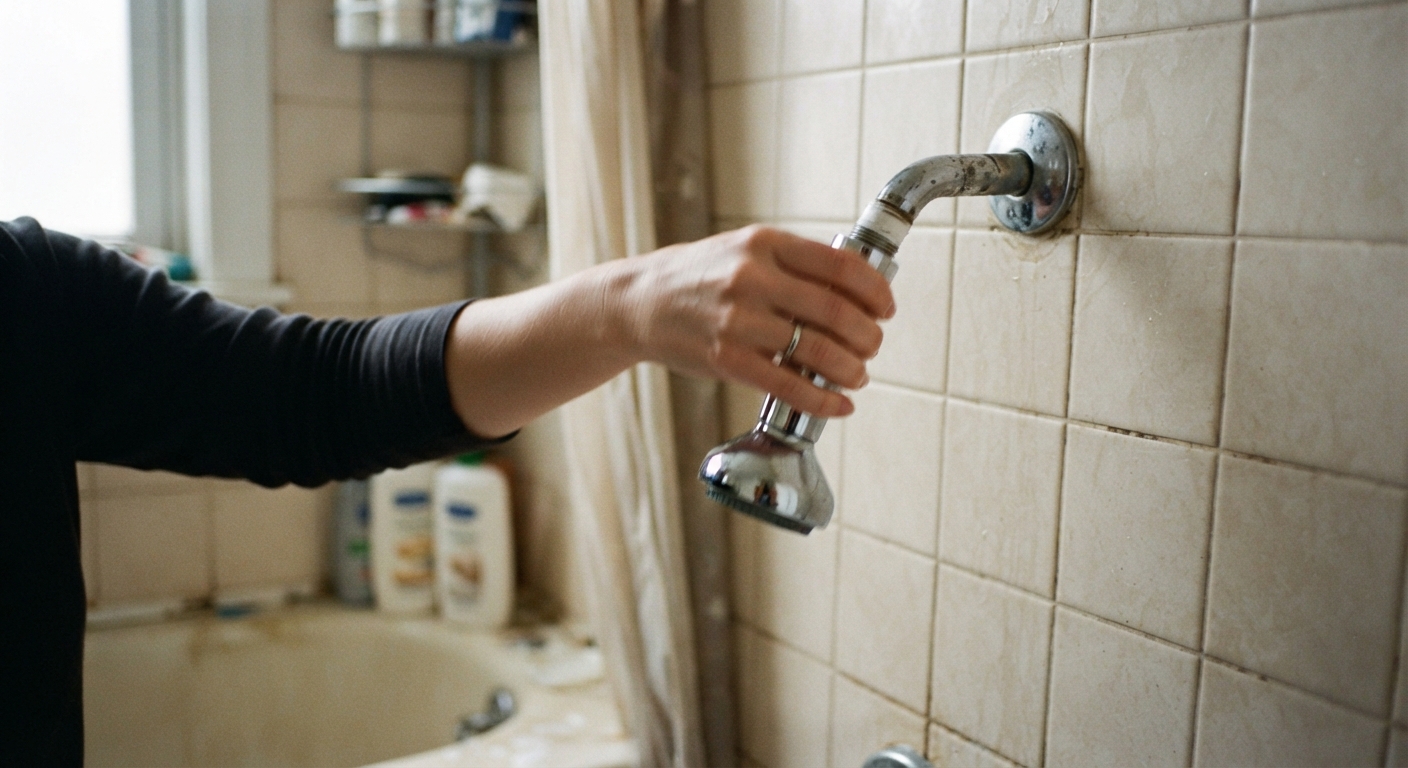
For a showerhead: unscrew the existing head by hand, turning counterclockwise. If it’s stuck from mineral buildup, a rag can give you better grip, but you shouldn’t need a wrench. Once it’s off, wrap the threads on the shower arm with a bit of plumber’s tape (a small roll costs next to nothing and prevents leaks), then screw the new low-flow head on by hand, snugging it with a slight quarter turn using a rag if needed. No tools required, no marks left behind.
Faucet aerators work the same way, just smaller. Unscrew the tip of the faucet counterclockwise — sometimes by hand, sometimes with a bit of grip from a rag — remove the old aerator screen, and thread in the new low-flow one. It usually takes less than a minute per faucet.
Because nothing is altered structurally and every part you removed is intact and reusable, this kind of swap doesn’t run into typical lease restrictions on modifications. You’re not repainting a wall or installing a fixture that requires new holes. You’re exchanging a consumable part for a better version of the same part, the same way you’d swap a lightbulb. Still, it’s worth keeping the original showerhead and aerators somewhere safe — a drawer, a bag in the closet — rather than in the trash, for reasons that matter at move-out time.
Packing and reinstalling fixtures when you move to a new rental
This is the detail that makes the whole strategy worth it for renters specifically: low-flow showerheads and aerators are yours to keep. You bought them, you installed them without altering anything, and you can take them with you exactly the same way you’d take a lamp or a curtain rod.
Before you move out, reverse the process. Unscrew your low-flow showerhead and aerators, and reinstall the original fixtures you saved in that drawer. This matters for two reasons. First, it keeps you from a possible move-out dispute over “who owns this part” — the property’s original fixture goes back exactly where you found it. Second, it means you don’t leave money behind. That $8 showerhead has more savings left in it, and there’s no reason to buy a new one in your next place when this one still works fine.
Pack your low-flow fixtures with your kitchen or bathroom boxes — small parts get lost easily, so a labeled zip-top bag taped inside a box lid works well. When you arrive at the new place, do the same swap in reverse: save whatever fixtures came with the new unit, install your own, and you’re back to lower bills within your first week in the new place instead of waiting months to get around to it.
Over several moves, this becomes a small, permanent piece of your moving kit — right up there with curtain rods and a shower liner, except this one actively lowers your bill everywhere you live.
Where to find the best-rated low-flow fixtures for under $15
You don’t need to spend much here, and you don’t need a plumbing supply store. Hardware stores and home improvement retailers carry low-flow showerheads in the roughly 1.5 to 2.0 GPM range for well under $15, often closer to $8 to $12 for a basic model with good reviews. Look for one that specifically states its GPM rating on the package — if it doesn’t list a number, skip it, because that’s usually a sign it’s an older-style high-flow head being sold without emphasis on efficiency.
General retailers and online marketplaces also carry multi-packs of faucet aerators, which is often the better deal since you need more than one anyway. A pack covering both bathroom and kitchen aerators usually runs a few dollars per piece, and buying them together means you’re not paying separate shipping or making multiple trips.
When comparing options, prioritize two things: a stated GPM number and a decent volume of user reviews mentioning water pressure. The GPM tells you the efficiency; the reviews tell you whether “low-flow” in this case still means a shower that feels adequate. The sweet spot for most households is a showerhead in the 1.5 to 1.8 GPM range with aerated or pressure-compensating design, paired with aerators rated around 1.0 to 1.5 GPM for the kitchen and slightly lower for bathroom sinks.
None of this requires research beyond reading the box. It’s a fifteen-dollar fix, a five-minute install, and a change that keeps saving you money every month it’s in place — and every month after that, in whatever place you live next.