The leak you can’t see: why food waste costs more than brand choice
If you’ve ever tried to shrink your grocery bill, you probably started with the obvious stuff: switching to store brands, clipping digital coupons, buying in bulk when you can. Those things help. But there’s a bigger leak in most kitchens, and it’s the one nobody budgets for on purpose: food that gets bought, forgotten, and thrown away.
Think about the last time you cleaned out your fridge. There was probably a bag of spinach gone slimy in the back, half a rotisserie chicken that got pushed behind the milk, a container of something you can’t identify anymore. None of that was a bad purchase at the time. It just lost the race against time because nothing in your routine was watching the clock for it.
This matters more than which brand of pasta sauce you buy, because waste isn’t a discount problem, it’s a full-price problem. When food spoils before you eat it, you paid full price for something that did nothing but sit in the trash. No coupon fixes that. The only fix is a routine that catches food before it turns, and that routine is what actually moves the needle on a grocery budget, month after month, without you having to eat worse or spend more time cooking.
The good news is that this isn’t about becoming a meal-prep person or tracking every item with an app. It’s a handful of small habits, done on a weekly rhythm, that make your existing groceries last as long as they’re supposed to. Here’s how to build that routine.
Setting up a “use-first” zone in your fridge and pantry
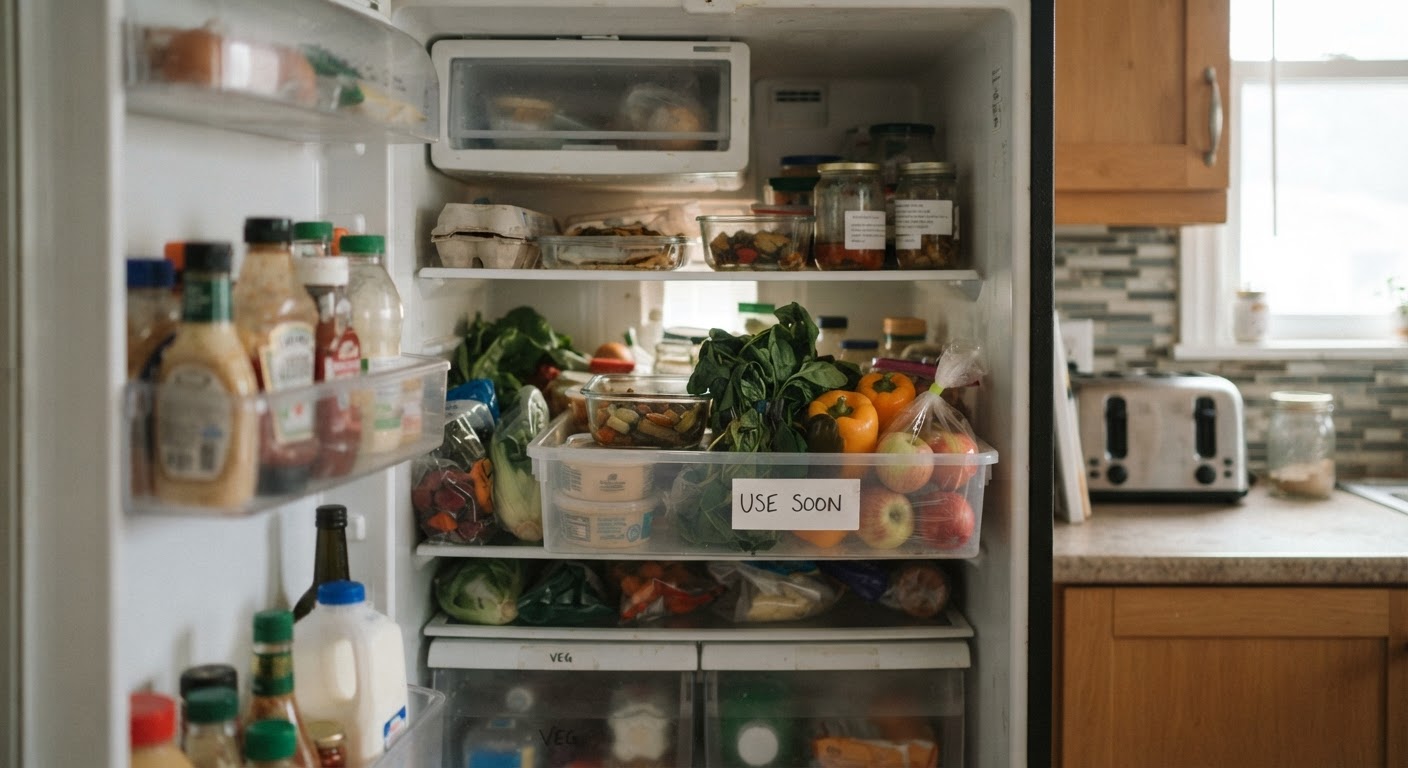
Most food gets wasted not because it went bad too fast, but because it went bad out of sight. You bought it with good intentions, put it away, and then something newer landed in front of it. The fix is embarrassingly simple: give the food that needs to be eaten soon its own dedicated space, at eye level, where you can’t miss it.
Pick one shelf in your fridge, ideally the one you look at first when you open the door, and make it the “use-first” shelf. Anything that’s opened, close to its date, or leftover from last night’s dinner goes there and nowhere else. Don’t let it get buried behind the newer groceries. When you unpack a grocery haul, the new stuff goes to the back or the bottom, and the older stuff gets pulled forward into the use-first zone.
Do the same thing in your pantry with a small basket or bin near the front. Bread that’s getting close to stale, crackers that are half-finished, the last of a bag of rice from two boxes ago. If it’s not visible, it doesn’t exist in your meal planning, and that’s exactly how it ends up wasted.
This works because it removes the guesswork. You shouldn’t have to remember what’s about to go bad. You should be able to open the fridge and see it immediately, the same way you’d notice a stack of mail on the counter. The goal is to make “what needs to be eaten” a visual fact, not a mental task you have to hold onto all week.
One small trick that helps a lot: keep a cheap dry-erase marker or a pad of sticky notes near the fridge, and jot down anything that goes into the use-first zone with the day you put it there. It takes ten seconds and it means you’re not relying on memory or smell to decide what needs to get used tonight.
A simple weekly rotation for checking dates before they sneak up on you
Dates don’t sneak up on food. They sneak up on you, because there’s no moment in a normal week where you’re actually looking at them. The fix is to build one specific check-in into your week, the same way you might have a day for laundry or bills.
Pick a day, ideally the day before your regular grocery trip, and spend ten minutes doing a fridge and pantry walk-through. You’re not reorganizing anything. You’re just looking at what’s in there and asking three questions: What’s close to its date? What have we not touched in a few days? What do we already have that overlaps with what’s on this week’s grocery list?
That last question matters more than people realize. A huge amount of waste comes from buying something you already had, because you didn’t check before you shopped. If there’s already a bag of shredded cheese in the use-first zone, you don’t need another one this week, you need a meal that uses it up.
This is also the moment to move anything you find into that use-first zone if it isn’t already there, and to make a short mental (or written) list of two or three things that need to get eaten in the next two or three days. You’re not trying to plan the whole week around leftovers. You’re just making sure nothing falls through the cracks between now and your next shopping trip.
If ten minutes a week sounds like too much of a commitment, try pairing it with something you already do, like putting away groceries or making a grocery list. The check happens naturally if it’s attached to something that’s already part of your rhythm, rather than being its own separate chore you have to remember.
Turning odds and ends into one “clean-out” meal a week
Here’s the piece that actually saves the most money: pick one night a week that’s dedicated to using up whatever’s accumulated in the use-first zone, no matter what it is. Call it clean-out night, fridge soup night, whatever sticks. The point is that this meal isn’t planned in advance with a recipe. It’s built from what’s already there.
This works for almost any kind of household. A half bag of vegetables, some leftover rice, the last bit of a rotisserie chicken, and a splash of broth becomes soup or fried rice. Odd ends of cheese and half a jar of sauce becomes a pantry pizza on flatbread or tortillas. Wilting greens and a couple of eggs becomes a frittata. The specific dish doesn’t matter. What matters is that it’s a standing appointment on your calendar, so it happens on purpose instead of only happening by accident when the fridge gets too full to ignore.
If you plan your grocery list around a normal week of dinners, leave one night intentionally blank. Don’t assign it a meal ahead of time. That blank spot is where the odds and ends go, and it also gives you a built-in buffer if the week gets busy and you need a low-effort dinner anyway.
A few households find it helps to keep this loose and low-pressure by not expecting it to be a “real” meal every time. Some weeks it’s a full dinner. Other weeks it’s just using up the last of the vegetables in an omelet for breakfast, or turning stale bread into croutons or French toast. The goal isn’t a gourmet clean-out dish, it’s just making sure nothing in that use-first zone gets forgotten again.
Kids and picky eaters can make this trickier, and that’s fair. If a full mixed dinner is a hard sell, try folding clean-out ingredients into something familiar instead of inventing something new. Extra vegetables go into a pasta sauce or a quesadilla instead of standing alone on a plate. The routine stays the same, the presentation just adapts to what your household will actually eat.
Storage fixes that actually extend shelf life
Even with a great routine, some food goes bad faster than it needs to simply because of how it’s stored. A few small adjustments buy you real extra days, sometimes close to a week, without changing what you buy or how much.
Produce is the biggest opportunity here. Most bagged greens and vegetables last longer if you don’t store them in the bag they came in. A slightly damp paper towel wrapped around greens, then placed in a container or a reusable bag, keeps them crisp far longer than a plastic grocery bag with the air trapped inside. For things like berries, a quick rinse in a mix of water and a little vinegar, then a thorough dry before refrigerating, slows down the mold that usually shows up within a couple of days.
Fruits and vegetables that release a lot of ethylene gas, like apples, bananas, and tomatoes, ripen everything around them faster if they’re stored close together. Keeping them separate from more delicate produce, like berries or leafy greens, means less of everything going soft or moldy at the same time.
Bread is another common casualty. If you don’t go through a loaf quickly, the fridge is actually the wrong place for it, since it can dry bread out faster than it goes moldy on the counter. Freezing half a loaf as soon as you bring it home, and pulling out slices as you need them, keeps it fresh far longer than trying to finish it before it turns.
Dairy lasts longer with basic attention to placement. The door of the fridge is usually the warmest part, because it’s exposed to room temperature every time you open it. Milk, in particular, holds up better on an interior shelf than tucked into the door, even though most fridges are designed with a milk slot right there. Cheese does best wrapped in wax or parchment paper rather than sealed tightly in plastic, which traps moisture and speeds up mold.
None of these storage tweaks require buying anything expensive or overhauling your kitchen. They just shift a few small habits around, so the food you already paid for gets a fair shot at being eaten instead of quietly going bad in the wrong spot.
Put together, a use-first zone, a weekly check-in, a clean-out meal, and a few storage adjustments don’t take much time, but they close the exact gap where grocery money disappears without you noticing. It’s not about spending less at the store. It’s about making sure more of what you already bought actually makes it to the table.