How many gallons per load each washer type really uses
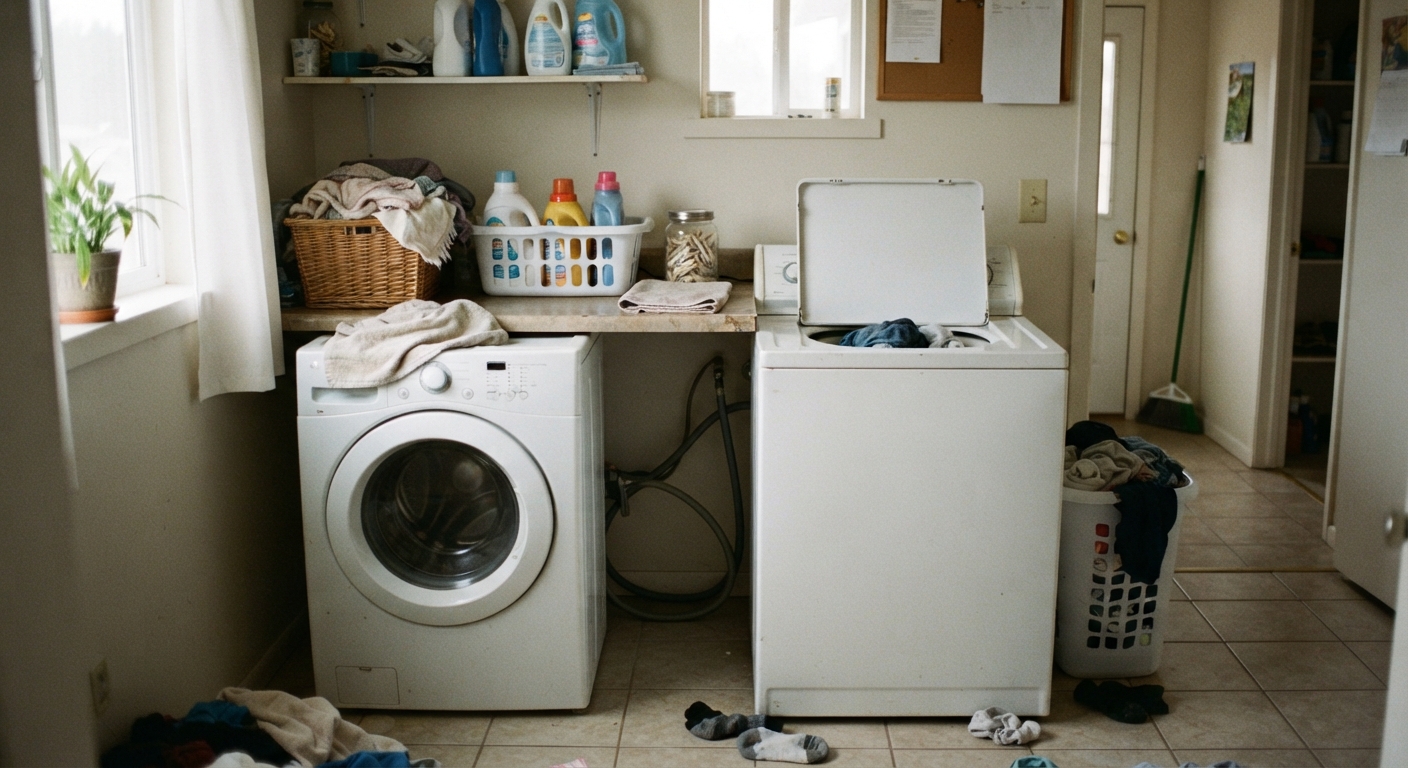
Here’s the split that matters: front-load washers typically use somewhere in the range of 10 to 20 gallons per load, while older or standard top-load washers with a center agitator can use 30 to 45 gallons per load. Newer high-efficiency top-loaders (the kind without the center post, with a wash plate at the bottom instead) fall somewhere in between, often landing in the 15 to 25 gallon range.
The reason for the gap comes down to how each machine actually washes clothes. A traditional top-loader fills a tub deep enough to fully submerge your clothes, then an agitator twists and churns them through that water to work out the dirt. That means every load needs enough water to cover everything, whether you’re washing a full load of towels or three shirts.
A front-load washer skips the full-submersion approach entirely. The drum tumbles clothes through a much shallower pool of water at the bottom, lifting and dropping them repeatedly. It’s a more mechanical, gravity-driven process, and it just doesn’t need as much water to get the same result. High-efficiency top-loaders borrow a version of this idea, using a wash plate that tumbles clothes without fully submerging them, which is why they land closer to front-loaders on water use than to old-school agitator machines.
None of this is marketing spin. It’s a straightforward function of design. If your washer has a big center post sticking up in the middle of the tub, you’re almost certainly on the higher end of that water range, and that’s the machine worth paying attention to in this article.
Doing the yearly math based on average loads per household
A household with a couple of kids commonly runs somewhere around 300 to 400 loads a year. If you’re doing roughly one load a day, you’re on the lower end of that range. Two loads a day during busy weeks, and you’re closer to 400 or higher.
Let’s use 300 loads a year as a conservative middle-ground number, since it’s easy to scale up or down for your own household.
At 40 gallons per load with an old-style top-loader, that’s 12,000 gallons a year going through your machine. At 15 gallons per load with a front-loader, the same 300 loads only uses 4,500 gallons. That’s a difference of 7,500 gallons a year from the washer alone, without changing a single habit about how much laundry you do.
Now, what that means for your actual water bill depends entirely on how your water utility charges you, and this is where it gets a little unpredictable. Some utilities charge a flat rate per unit of water (often billed in units of 1,000 gallons or per hundred cubic feet), and some layer on tiered pricing where your rate per gallon goes up once you cross a certain usage threshold. If you’re on a tiered plan and laundry water use is what’s pushing you into a higher tier, the savings from switching machines can be more meaningful than the raw gallon numbers suggest, because you’re not just saving gallons, you’re potentially dropping back into a cheaper pricing tier altogether.
There’s also a second savings layer that’s easy to miss: hot water. If you wash on warm or hot cycles regularly, a front-loader heating less water per load means a smaller chunk of your energy bill too, on top of whatever you’re saving on the water side. For households paying separately for water heating (electric, gas, or otherwise), that’s worth factoring in even though it shows up on a different bill.
The honest takeaway here is that the water bill savings from switching washer types are real but modest for most people, generally not life-changing on their own. Where it gets more worthwhile is when you stack it with the energy savings on hot water, and when you’re already due for a new washer anyway rather than replacing a working machine early just to save on water.
When a rental’s included washer makes this a moot point
If you’re renting and the washer came with the unit, most of what’s above is interesting to know but not something you can act on directly. You can’t swap out a landlord’s machine for a different type, and you shouldn’t spend money trying to.
There are a few situations worth knowing about, though. Some landlords are open to a tenant-funded upgrade if you ask, particularly if the existing washer is old and likely to need replacing soon anyway. It doesn’t hurt to mention it, especially if you frame it as something that benefits the unit long-term, not just your bill. Just get anything agreed to in writing before you spend a dime, including who owns the new machine if you move out.
If you’re in a building with shared laundry rooms rather than an in-unit machine, this whole comparison mostly doesn’t apply to your water bill, since you’re typically paying per load or it’s bundled into rent rather than metered to your individual usage. In that case, your energy comes from focusing on load size and cycle choice rather than machine type, since you have no control over which machine is installed.
And if water is included in your rent as a flat utility fee rather than metered separately, switching machine types won’t move your bill at all, no matter how much water the washer uses. In that case, this is genuinely a non-issue for your budget, and your energy is better spent elsewhere in this guide.
The households where this actually matters are the ones who own their washer, or rent a house where water is metered and billed to them directly. If that’s not your situation, feel free to skip ahead to the workarounds section below, since some of those tips help regardless of who owns the machine.
Cheap workarounds if you’re stuck with a water-hungry top-loader
If you’ve got an old agitator-style top-loader and replacing it isn’t realistic right now, there’s still room to bring your water use down without buying anything new.
Start with load size settings. Most top-loaders let you choose a water level (small, medium, large, or similar), and a lot of people just leave it on the same setting every time regardless of how full the tub actually is. Matching the water level to the actual size of the load, rather than defaulting to large out of habit, is the single easiest fix and costs nothing.
Skip the pre-soak or extra rinse cycles unless you actually need them. Both add a full extra fill of water to a load. If your clothes aren’t particularly dirty or you’re not dealing with allergies or sensitive skin that require an extra rinse, cutting these out is free money back in your pocket every time you do laundry.
Wait for full loads when you can, especially with towels, sheets, and bulky items. A half-full load in a large-capacity top-loader still often fills to a similar water level as a fuller one, so you’re using close to the same amount of water either way. Consolidating two half-loads into one full one is one of the more painless ways to cut total loads per week.
Wash in cold water when the fabric and stain allow it. This doesn’t reduce the gallons used, but it reduces the energy cost of heating that water, which is often the bigger hidden cost tucked inside your laundry routine anyway.
If your top-loader has a “deep water wash” or similar boost option, know that it exists specifically to add more water than the automatic sensor would otherwise use. It’s meant for very large or heavily soiled loads. Leaving it switched on as a default is one of the more common ways people unknowingly inflate their water use without realizing that setting is even active.
None of these tricks turn a thirsty top-loader into a front-loader. But stacked together, they can meaningfully close the gap, especially the load-size-matching habit, which tends to make the biggest single dent for the least effort.
Signs your current machine is using more water than it should
Sometimes the issue isn’t the type of washer you own, it’s a machine that’s using more water than even its own design calls for. A few signs are worth checking for.
If your washer seems to fill for longer than it used to, or you notice the water level rising well above where your clothes sit even on a normal setting, the water level sensor may be failing. These sensors read pressure or water height and tell the machine when to stop filling. When they go bad, machines commonly default to overfilling rather than underfilling, since manufacturers would rather risk wasting water than risk clothes not getting clean.
Check your fill hoses and connections for slow leaks, particularly where the hose meets the wall valve and where it connects to the back of the machine. A slow drip you never see pooling on the floor can still add up over a year of loads, and it won’t show up as anything more dramatic than a slightly higher bill than you’d expect.
If your machine has a lid or door switch that’s worn out, some washers will actually run extra fill cycles or repeat parts of the wash trying to compensate for what the machine interprets as an interruption. This is less common but worth ruling out if your washer seems to be taking longer and running noisier than it used to for a load that hasn’t changed size.
Finally, an unusually high water bill in a month where your laundry habits genuinely haven’t changed is worth investigating on its own, separate from anything about washer type. It’s easy to assume the increase is the washer, but toilets with slow leaks, dripping outdoor spigots, and irrigation timers left running are all common culprits that get blamed on laundry simply because laundry is the most water-intensive appliance most households run regularly. If your bill jumps and you can’t explain it through more loads or bigger loads, it’s worth a quick check around the rest of the house before assuming the washer is the source.