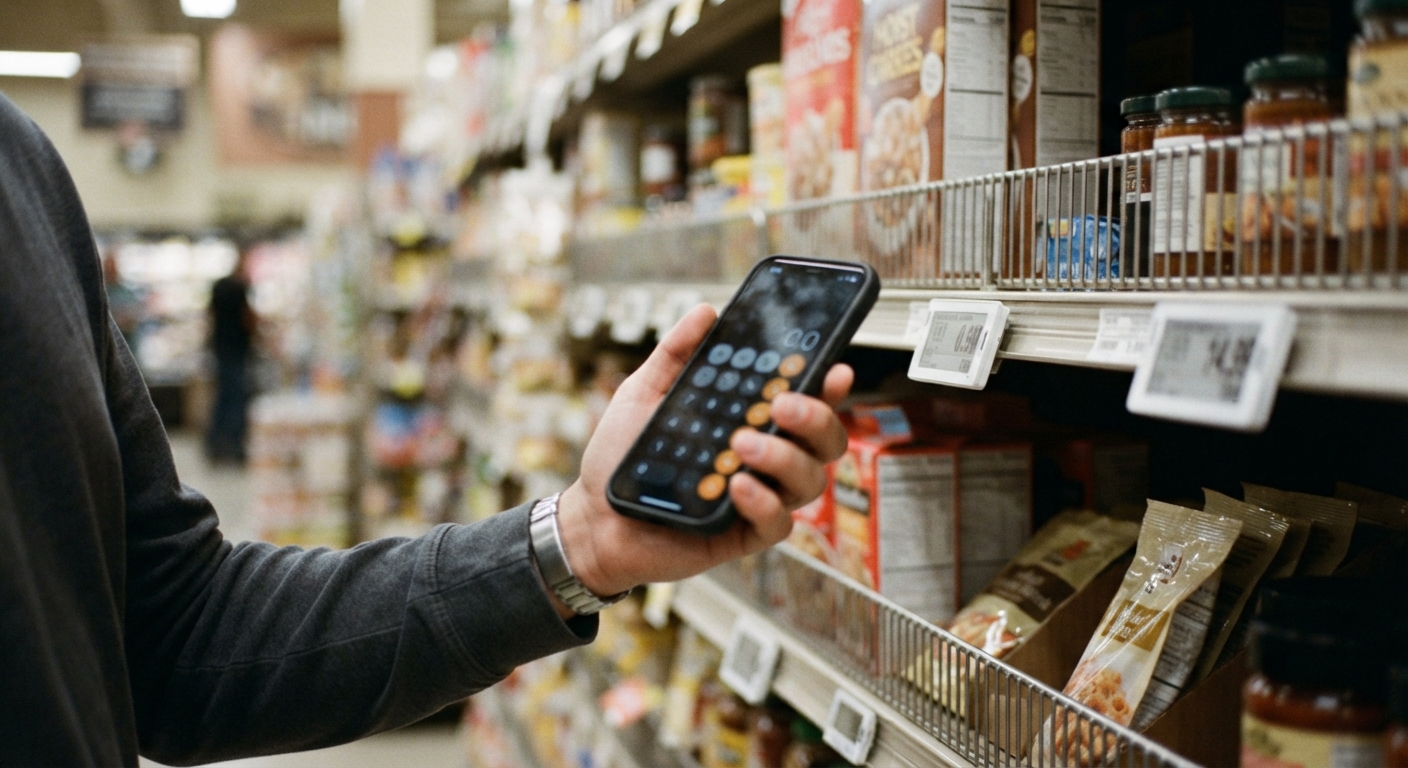
You’ve been trained to trust that little sticker on the grocery shelf. It sits under the price tag in smaller print, usually something like “$0.24/oz” or “$0.08/sheet,” and it’s supposed to be the great equalizer — the number that cuts through fancy packaging and tells you which product is actually cheaper. Most of the time it does its job. The problem is the units themselves aren’t standardized across brands, and that’s where a lot of shoppers end up paying more while thinking they scored a deal.
Why the shelf tag unit isn’t always the same across brands
Here’s the trick nobody tells you about: two nearly identical products sitting side by side can be priced per different units. One brand of shredded cheese might list price per ounce, while the store brand right next to it lists price per pound. One paper towel roll might be priced per sheet, another per roll, and a third per square foot if it’s an “ultra” or “select-a-size” version with bigger sheets. Laundry detergent is even worse — some tags show price per ounce of liquid, others show price per load, and “loads” are defined differently by every manufacturer depending on how concentrated the formula is.
This isn’t necessarily a conspiracy. Store systems often just pull whatever unit is on the manufacturer’s packaging data. But the effect is the same either way: you glance at two tags, see two numbers, and assume you’re comparing apples to apples when you’re actually comparing ounces to loads, or sheets to square feet. The only way around this is to actually look at what unit each tag is using before you compare them, not just at the number itself.
A good habit is to pick one unit you want to think in — ounces for most food and cleaning products, per-load for laundry, per-sheet for paper goods — and mentally convert anything that isn’t already in that unit. It sounds like extra work, but after you’ve done it for your regular items a few times, you’ll just know the numbers without thinking.
How to do quick unit math in your head or with your phone calculator in the aisle
You don’t need to be fast at mental math to catch a bad deal. You need one simple move: price divided by quantity, done consistently for every item you’re comparing. If the shelf tag unit is unclear or missing — which happens more than it should, especially on sale items where the sticker gets covered by a bright yellow “SALE” tag — just pull out your phone.
Here’s the move: check the total price, check the total ounces (or count, or sheets) on the package itself, and divide. Price divided by quantity equals your real cost per unit. Do this for both products you’re considering, using the same unit for each, and now you have an actual comparison instead of a guess.
A few practical shortcuts that make this faster in the aisle:
Round numbers before you divide. You don’t need the answer to three decimal places — you’re not filing taxes, you’re deciding between two bags of rice. If one package is $4.98 for 32 ounces, round it to $5 for 32 ounces and you’ll land close enough to the real number to make a good call.
Use your phone’s calculator app, not your head, whenever the numbers aren’t round. It takes ten seconds and removes all doubt. If you’re regularly comparing the same handful of items, this is also a good moment to jot the result somewhere — more on that in the price book section below.
When in doubt, convert everything to the smallest common unit. Ounces work for almost all packaged food and liquid products. Individual sheets or wipes work for paper goods. Doing this consistently means you’re never accidentally comparing a pound of something to an ounce of something else and thinking you found a bargain.
The “bigger box, same price per unit” trap
This one catches even careful shoppers. You see a “family size” or “bulk value” box that costs more than the regular size, and your brain does a quick shortcut: bigger box, more product, must be the better deal. Sometimes that’s true. Often it isn’t — the unit price on the bigger box is identical to, or even higher than, the smaller one. The store isn’t giving you a bulk discount; they’re just selling you more volume at the same rate, or occasionally at a slightly worse rate, and counting on the “bigger must be cheaper” instinct to do the rest.
This trap shows up most with items marketed around convenience or a seasonal push — think holiday-sized snack boxes, “back to school” multi-packs, or big jugs of cleaning products positioned as if they were a special value. The packaging language does a lot of the selling: words like “value size,” “family pack,” and “bonus” are not regulated claims about price. They just mean the box is bigger.
The fix is boring but effective: always check the per-unit number on the bigger package against the per-unit number on the smaller one before you commit. If they’re the same, buy whichever size actually matches how much of the product you’ll use before it goes stale, expires, or takes up space you don’t have. There’s no point saving a theoretical two cents an ounce on a jumbo box of crackers that goes soft before you finish it.
It’s also worth remembering that bigger packages aren’t a deal at all if you end up throwing part of them away. A giant bag of shredded cheese that molds before you’re halfway through erases whatever unit-price advantage it had on the shelf.
Categories where unit pricing lies the most
Some aisles are worse offenders than others. If you’re going to spend your limited “let me actually check the math” energy anywhere, spend it here.
Cereal is a classic. Boxes vary wildly in how much air is packed in versus actual product weight, and brands frequently redesign box shapes — taller, shorter, wider — without changing the name or the shelf position, which makes a visual size comparison useless. Always go by the weight printed on the box, and check the unit price per ounce rather than judging by how big the box looks in your hand.
Paper products are arguably the worst category for this. Paper towels get sold by roll count, sheet count, and “size” all at once, and manufacturers regularly shrink the sheet size while keeping the roll count the same, so a “12-pack” this year might contain noticeably less paper than a “12-pack” from a couple of years ago. Toilet paper has the same issue with “mega rolls,” “double rolls,” and “regular rolls” all meaning different things depending on brand. The only reliable number is total sheet count or total square footage, if it’s listed — and if it’s not listed, that’s itself useful information, because a brand that doesn’t want you doing that math usually has a reason.
Cleaning supplies, especially concentrated ones, play the same game with “loads” and “uses.” A bottle that claims “80 loads” versus another that claims “64 loads” isn’t necessarily a fair fight if the two brands define a load differently in terms of concentration or scoop size. When you can, compare by total ounces or total weight of product rather than trusting the load or use count printed on the front, since that number is chosen by the manufacturer’s marketing team, not by a neutral standard.
Building a personal price book for the items you buy most often
Unit pricing tricks are annoying in the moment, but the real long-term fix is not needing to relitigate the math every single week. That’s what a price book is for. It sounds more formal than it is — really it’s just a running note on your phone, or a small notebook if you’d rather write it by hand, where you track the unit price of the products your household buys on repeat.
Start small. Pick the ten to fifteen items you buy almost every trip — milk, eggs, a particular cereal, paper towels, laundry detergent, coffee, whatever shows up in your cart week after week. For each one, note the store, the brand, the size, and the unit price you calculated. The next time you’re in the aisle, you don’t have to redo the math from scratch — you just check whether today’s price beats your recorded baseline.
This does two things for you. First, it flags real sales versus fake ones. Stores rotate “sale” signage constantly, and not every sale tag reflects an actual price drop from what you’d normally pay — sometimes it’s a sale off an inflated “regular” price that nobody actually pays. If your price book says you’ve paid less than the “sale” price before, you know to skip it or wait.
Second, it lets you compare across stores without needing to visit them all on the same day. If you shop at more than one grocery store, or split trips between a regular grocery store and a discount or bulk store, your price book becomes the tool that tells you where each item is genuinely cheapest, rather than relying on a general feeling that one store is “better” for groceries.
You don’t need to track everything — that turns a useful habit into a chore you’ll abandon in a week. Stick to the items you buy often enough that a few cents per unit actually adds up over a year, and let everything else stay a normal, un-tracked purchase. Update the book every month or two, since prices shift and package sizes get quietly redesigned more often than you’d expect.
None of this requires spreadsheets or apps you have to pay for. A notes app, a sticky note in your wallet, or a page in a notebook you keep in your grocery bag all work fine. The goal isn’t precision — it’s giving yourself a quick reference so you’re not doing fresh unit math under fluorescent lighting every single week, and so the “deal” signage on the shelf has to actually earn your trust before you believe it.