Most people don’t notice a leak because it doesn’t announce itself. There’s no puddle, no drip you can hear over the TV, no obvious sign anything’s wrong. A running toilet can waste a serious amount of water every single day and sound almost exactly like normal flushing. A faucet that drips once every few seconds seems too small to matter, but multiply that by 24 hours and 30 days and it adds up to a lot of gallons you’re paying for and getting nothing out of. Pipes hidden in walls or under slabs can leak for months before anyone sees a stain.
Water bills are also weird compared to other household costs. Your electric bill goes up gradually when it’s hot outside, and you can usually feel why. Your water bill can jump overnight because of something you can’t see, can’t hear, and would never think to check. By the time the bill arrives, the leak has already been running for a full billing cycle, sometimes longer if you don’t catch it right away. That’s the trap: the cost of a leak isn’t just the water, it’s the water multiplied by however long it takes you to notice.
The good news is that almost all leaks are catchable with a quick, free test using nothing but your water meter and about five minutes of your time. Do this once a month and you turn an invisible problem into something you catch early, before it turns into a bill that makes you do a double take.
The meter test: how to check for leaks in under five minutes without any tools
You don’t need a plumber or any equipment for this. You just need access to your water meter, which is usually outside near the curb, in a utility closet, in the basement, or sometimes in a pit with a lid you lift with your fingers or a screwdriver. If you rent and don’t have direct access to a meter, skip ahead to the room-by-room checklist below, since that part works for anyone regardless of who controls the meter.
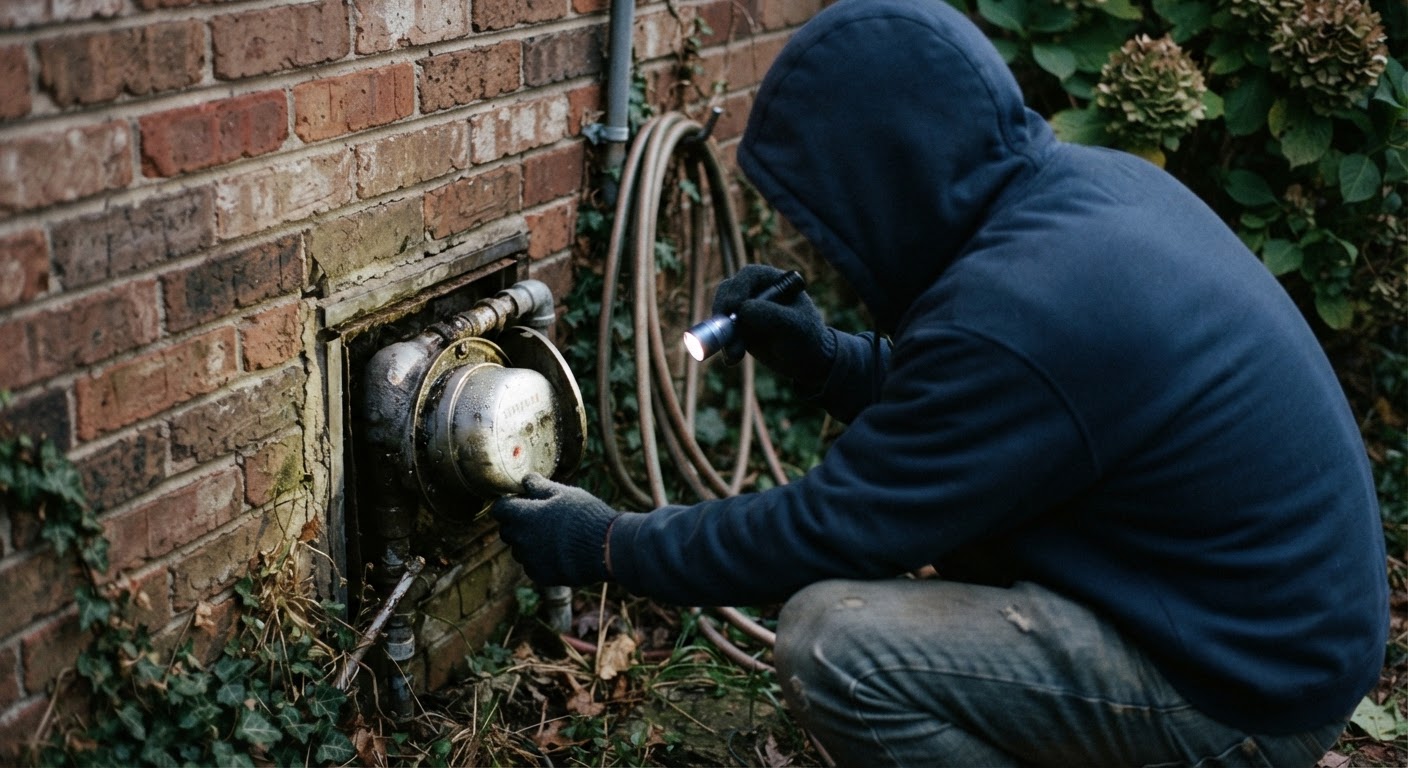
Here’s the test. Make sure no water is being used anywhere in the house for about ten minutes. That means no dishwasher, no washing machine, no one flushing a toilet or running a tap, and if you have an automatic ice maker or irrigation system, those should be off too. Once things are quiet, go find the meter and look at the numbers, or find the small leak indicator dial or triangle that many meters have. That little dial is designed to spin if even a trickle of water is moving through the line, so if you see it turning while everything in the house is off, that’s your answer right there.
If your meter doesn’t have a visible leak indicator, just write down the reading, wait fifteen minutes without using any water, then check it again. If the number moved at all, water went somewhere it shouldn’t have. Two readings, fifteen minutes apart, no fancy tools required.
This test won’t tell you exactly where the leak is, but it tells you definitively whether one exists. That’s the whole point. It turns “I have a bad feeling about my last bill” into “yes, there’s a leak, time to go find it” or “no, everything’s fine, check again next month.” Either answer is useful, and either way you’ve spent five minutes instead of discovering the problem through a bill that makes your stomach drop.
Room-by-room checklist: toilets, faucets, water heater, outdoor spigots
If the meter test tells you there’s a leak, or even if you just want to be thorough without touching the meter at all, walk through the house room by room. This part takes a little longer but it’s still doable in one pass on a Saturday morning.
Start with every toilet in the house, because toilets are far and away the most common source of a hidden water leak. The classic trick is the food coloring test: put a few drops of food coloring in the tank, wait about ten minutes without flushing, then look in the bowl. If any color shows up in the bowl, water is leaking from the tank into the bowl through a worn flapper or a valve that isn’t seating properly, and that’s water running down the drain around the clock even when nobody’s used the toilet. You can also just lift the tank lid and listen. A tank that’s quietly hissing or trickling when it should be sitting still is telling you something.
Next, check every faucet, including ones you don’t use often like a laundry room sink, a wet bar, or a bathroom that’s mostly for guests. Run each one, then turn it off firmly and watch for a few seconds. A slow drip after the handle is fully closed usually means a worn washer or cartridge inside the faucet, which is a cheap and common fix.
Then look at your water heater. Check around the base for any dampness, water stains, or a small puddle, and look at the pressure relief valve and any visible fittings for drips. A water heater that’s slowly leaking is not just a water bill problem, it’s also a sign the unit itself may need attention, so this is worth catching early for more than one reason.
Finally, go outside and check every spigot, hose bib, and irrigation connection if you have one. Turn each spigot on and off and watch the connection point where a hose attaches, since that’s a common spot for a slow leak that just soaks into the ground where nobody sees it. If you have a garden hose that’s always attached, disconnect it for a moment and check the spigot itself, since a leak underneath a hose can hide for a long time.
Going room by room like this usually takes fifteen to twenty minutes the first time, but once you know where the trouble spots are, later checks go much faster because you know exactly what to look at.
How to tell the difference between a leak you can fix yourself and one to report
Not every leak is a do-it-yourself job, and knowing which category you’re dealing with saves you time and keeps you from making a small problem bigger.
Generally, leaks inside a toilet tank, like a worn flapper or a wobbly fill valve, are simple and cheap to fix yourself with a part from any hardware store, and there are plenty of straightforward guides for swapping one out. A dripping faucet handle is usually the same story: a washer or cartridge replacement that most people can do with basic tools and a little patience. These are the leaks worth just fixing, whether you own your place or rent it, since a quick trip to the hardware store often costs less than a single month of wasted water.
Where it gets trickier is anything involving the water heater, a leak inside a wall, a leak under a slab foundation, or anything near the main shutoff valve or the meter itself. Those aren’t jobs to attempt without experience, and in a rental, they’re squarely the landlord’s responsibility to fix, not yours. If you rent and find a leak in one of these spots, put your request in writing, even if you also mention it verbally or by text, so there’s a clear record of when you reported it and what you reported. That paper trail protects you if the leak continues and shows up on a water bill that you’re responsible for, especially in situations where water is a separate charge from rent.
If the meter test showed movement but you’ve checked every toilet, faucet, and visible pipe and found nothing, the leak is likely underground or inside a wall, between the meter and the house. That’s the moment to contact either your utility company or your landlord, depending on who owns that section of the line. Many water utilities will actually send someone out to check for exactly this kind of leak, and it’s worth asking, since finding it early can save both you and them a lot of wasted water. In a rental, this is squarely a landlord or property management issue, and reporting it promptly is the right move rather than trying to trace pipe under a slab yourself.
A simple rule of thumb: if you can see it, reach it, and the part costs a few dollars at a hardware store, it’s probably yours to fix. If it involves cutting into a wall, digging up ground, or touching the main line, it’s time to call in the utility or the landlord.
Setting a recurring reminder so this becomes a monthly habit instead of a one-time fix
The real value of this five-minute check isn’t in doing it once, it’s in doing it every month, right around the time your water bill usually arrives. A single check might catch a leak that’s already been running for weeks. A monthly habit catches leaks within days of them starting, before they’ve had time to cost you much of anything.
The easiest way to make this stick is to tie it to something you’re already doing regularly, so you don’t have to rely on remembering out of nowhere. If you pay bills on a certain day of the month, do the meter check right before or after that. If you already have a habit of checking your thermostat or changing an air filter on a schedule, add the water check to that same day. A recurring phone reminder or a note on the calendar works just as well, and it’s a five-minute task, so there’s no real barrier to actually doing it once it pops up.
It also helps to keep a very simple written record, even just a note in your phone: the date you checked, whether the meter moved, and anything you noticed in the room-by-room walk-through. Over a few months, this gives you a baseline for what normal looks like in your house, which makes it much easier to spot when something’s off. If your water bill runs about the same for six months and then suddenly climbs, your notes will help you figure out whether that lines up with something you’ve already caught and fixed, or whether it’s a sign to go check again right away, bill cycle or not.
None of this requires special skills or spending money upfront. It’s five minutes of attention, done consistently, that stands between you and the kind of water bill that throws your whole month’s budget off. Leaks don’t wait for a convenient time to happen, but if you’re checking every month, you’ll almost always catch them while they’re still small and cheap to fix, instead of finding out the hard way when the bill lands.