Why buying by the case beats even warehouse club prices
Warehouse clubs already showed you that bigger packages mean lower per-pound prices. But clubs still have to mark things up enough to cover a membership desk, a huge retail footprint, and profit margins on everything from tires to rotisserie chickens. Butchers, produce distributors, and restaurant supply stores are selling to businesses that need thin margins and fast turnover, not to shoppers browsing for a bargain. When you buy a full case, a whole loin, or a 50-pound bag instead of a shrink-wrapped tray, you’re paying close to what a restaurant pays.
That’s the gap a bulk co-op is built to close. A case of chicken thighs split four ways can land well under grocery store price per pound, and the same goes for a flat of berries in season, a wheel of cheese cut into wedges, or a 25-pound bag of rice divided into five-pound portions. The catch is that almost nobody needs 40 pounds of chicken thighs or a full case of canned tomatoes at once. That’s where the neighbors come in — you’re not buying in bulk for your household, you’re buying in bulk for a small cluster of households and then breaking it back down to normal sizes.
Finding two to four households to split with
You don’t need a formal club or a website. You need three or four families who already trust each other a little and who eat somewhat similar things. The easiest places to find them are places you’re already standing around waiting: the school pickup line, a church group, a break room, a group text of parents from the same daycare or Little League team.
Start small and specific instead of vague. Don’t ask “does anyone want to do a buying co-op with me” — ask “I found chicken thighs for a good price by the case at [place], anyone want to split a case with me this week?” A concrete, one-time ask is much easier for someone to say yes to than an open-ended commitment. If it goes well, you’ll naturally fall into doing it again, and that’s how the group forms without anyone having to name it.
Four households is a good ceiling for an informal group. Much bigger than that and you’re doing spreadsheet-level coordination for what should be a fifteen-minute garage pickup. Two or three is honestly the sweet spot — small enough that everyone knows everyone, big enough that you can actually hit case-size minimums.
What’s worth splitting and what isn’t
The best candidates for splitting are things with a long shelf life once they’re in your freezer or pantry, and things that are sold in case sizes far bigger than one household eats before it spoils. Meat is the classic one — chicken thighs, ground beef, pork shoulder, whole briskets. Cheese in block form. Rice, dried beans, flour, and oil sold in restaurant-size bags and jugs. Cleaning supplies and paper products fall into the same category — nobody needs a case of dish soap, but four households splitting it barely notice the storage space and each save real money.
What doesn’t make sense is anything perishable and soft that you can’t freeze or preserve quickly — delicate berries, leafy greens, ripe avocados, anything that’s going to turn in three days whether you eat it or not. A flat of berries can work if everyone is picking up the same day and either eating fast or freezing immediately, but it only takes one household forgetting a bag on the counter for two days to sour the whole idea for them. If you’re new to this, start with the shelf-stable and freezable stuff and add produce later once the group has a rhythm.
Setting up a simple order-and-pickup rotation
The single biggest reason bulk co-ops fall apart isn’t the food, it’s the money and the logistics. Fix those up front with a plan simple enough to text.
Pick one person to be the “orderer” for a given purchase — usually whoever found the deal or has the best relationship with the seller. That person collects everyone’s share of the money before the order goes in, not after. This one rule prevents almost every awkward situation that follows. Nobody should be fronting money for someone else’s chicken thighs and then chasing them down for two weeks.
Rotate who does the ordering and who does the driving/pickup so it’s not always the same person’s Saturday getting eaten up. A simple pattern works fine: whoever suggests a deal that week is the orderer for that round, and pickup rotates in the order people joined. Write it down somewhere everyone can see — a shared note or a pinned message in the group text — so nobody has to rely on memory or goodwill for who’s up next.
Before anything is ordered, agree on the split: is it even shares regardless of what everyone actually wants, or does each household order the exact portion size they need and pay accordingly? Even splits are simpler math but only work if everyone genuinely wants the same amount. Custom splits are fairer but require the orderer to do a little more arithmetic. Either way, settle it before the money moves, not after the case shows up on someone’s porch.
Portion and freeze the same day
This is the step that turns a good deal into a food safety problem if you skip it. A case of meat that’s been sitting in a warm car or on a counter for a few hours before everyone picks up their share is already living on borrowed time. Plan pickups for a time when everyone can go straight home and deal with their portion within the hour, not “sometime today.”
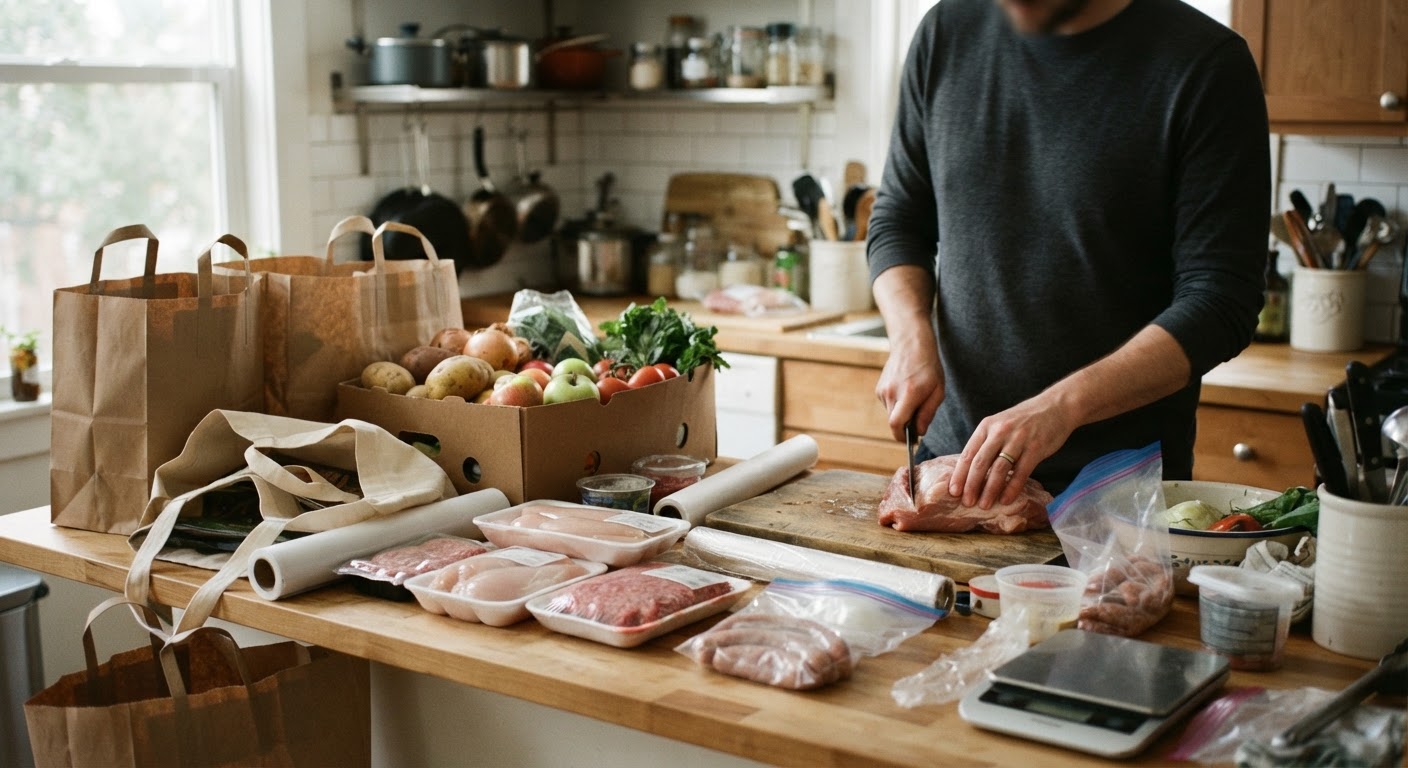
Have a portioning plan before pickup day, not after. That means bags, a marker, and freezer space ready to go. Break meat into meal-size portions immediately — don’t freeze a five-pound lump you’ll have to thaw entirely just to cook dinner for two. Label with the date and the cut, because six months from now you will not remember what’s in the unlabeled bag. Rice, beans, and oil are more forgiving and can wait a day, but anything that was refrigerated or frozen at the source needs to go straight back into your fridge or freezer, not sit in a warm kitchen while you finish other errands.
If a household in your group habitually can’t pick up same-day, that’s worth addressing directly rather than letting it slide — it’s not just an inconvenience, it’s a food safety issue for something you’re both financially and physically responsible for.
Sample math: what the savings actually look like
It helps to see the numbers laid out plainly, even with rough figures, because the case-size discount is often bigger than people expect.
Say boneless chicken thighs run a noticeably higher price per pound at a regular grocery store. A restaurant supply or butcher case price for the same cut, sold in a 40-pound case, often comes in meaningfully lower per pound — sometimes close to half, depending on the source. Split four ways, each household takes home ten pounds, pays a quarter of the case price, and still ends up spending less overall than they would buying two or three grocery store packages that add up to the same ten pounds.
Rice and dried beans follow a similar pattern: a 25-pound bag priced for bulk buyers costs a fraction per pound of what small bags cost individually, and split five pounds each among five households, everyone gets grocery-store quantities at well below grocery-store prices. Cheese sold as a wheel or a large block, cut down into wedges for four households, usually beats the pre-cut, pre-packaged block at the store too, partly because you’re skipping the packaging markup entirely.
None of this requires precise spreadsheets to notice. If you tally up what you spent for your share against what the same amount would have cost at your regular grocery store, the difference is usually obvious enough to convince you to do it again next month.
When someone drops out or doesn’t pay
It will happen eventually — someone’s paycheck timing shifts, a kid gets sick, life gets in the way. Handle it as a logistics problem, not a moral one, and the group survives it.
The “pay before ordering” rule mentioned earlier is your main defense: if money is collected up front, a household backing out before the order is placed costs nothing but a slightly smaller case order or a quick scramble to find a replacement share. The real trouble comes if someone commits, the order goes in, and then they can’t pay or don’t show up for pickup.
Decide in advance, even just once out loud in the group text, what happens in that case — usually it means the other households absorb the extra portion and split the added cost, or one household takes the extra share and pays for it themselves since they’re getting more food. Either way, having a default answer already agreed on means nobody has to negotiate it in the moment while feeling annoyed.
If someone is chronically late or unreliable, it’s fine to quietly let them not be included next time rather than making it a confrontation. A rotating, informal group has no obligation to include the same people every round, and that flexibility is part of why it works better than a formal club with membership rules.
When it stops being worth the effort
Bulk co-ops are worth doing when the savings are clear and the coordination is light — a text, a pickup, a portioning session, done. They stop being worth it when the coordination cost quietly grows past the savings: constant rescheduling, chasing payments, a group that’s grown too big to manage with a group text, or arguments over splits that take longer to resolve than the money saved is worth.
It’s also worth stepping back if your household’s actual usage doesn’t match case sizes well. If you’re freezing ten pounds of chicken thighs and still working through the last batch three months later, you don’t need this system, you need a smaller order or no order at all. The point isn’t to buy in bulk for its own sake — it’s to lower your real cost per pound for food your household actually eats before it expires. When it does that with minimal drama, keep it going. When it turns into a part-time logistics job, it’s fine to let it quietly fade and go back to shopping normally until a better opportunity — or a more reliable group of neighbors — comes along.