Why outdoor water use is the easiest place to cut usage without touching indoor habits
If you’re looking for ways to trim your water bill, outdoor use is where the real, painless savings live. Indoor water use is tangled up with daily routines you probably don’t want to mess with — showers, dishes, laundry, flushing. Nobody wants to time their kid’s bath or ration toilet flushes to save a few dollars a month. But outdoor water use, especially watering plants, rinsing patio furniture, or hosing down a balcony, is usually optional, flexible, and easy to swap out for free water that would otherwise just run down a storm drain.
This matters more in warmer months when outdoor watering can quietly become a big chunk of a water bill, even for renters with just a few pots or a small patch of garden. The nice part is that fixing this doesn’t require new habits or willpower. You’re not trying to use less water overall — you’re trying to use different water, water you didn’t pay for, for the tasks that don’t require treated tap water anyway. Plants don’t care if the water fell from the sky an hour ago or came through a meter.
Before you buy a single barrel or bucket, though, it’s worth understanding what’s actually allowed where you live and what your lease says, because rules on this vary a lot more than people expect.
Checking your city and state rules on rainwater collection before you buy anything
Rainwater collection is legal in the vast majority of places, but “legal” doesn’t always mean “unregulated,” and a few areas have specific rules about barrel size, overflow management, or where you can place a collection container. Some cities have no rules at all and even offer discounted barrels through local water utilities. Others have permit requirements for larger systems, or restrictions tied to mosquito control ordinances, which usually just mean your barrel needs a sealed lid or screen — an easy fix either way.
The fastest way to check is a quick search combining your city or county name with “rainwater harvesting rules” or a call to your local water utility, since many of them publish a short page on this exact topic. It’s also worth checking if your state has any water rights language that affects collection, which is more common in dry western states than anywhere else. For most renters in most cities, a basic barrel under a downspout is a non-issue. But five minutes of checking saves you from setting something up and then finding out your city has opinions about it.
Once you’ve confirmed it’s allowed locally, the next layer to check is your lease.
What landlords typically allow versus what requires written permission
Landlords generally care about three things: does this change the structure of the property, does it create a liability or mess, and does it look bad to neighbors or the HOA. A freestanding rain barrel sitting on a patio or under a downspout usually clears all three bars without any issue, since it’s not attached to anything and can be removed in five minutes.
What typically does require asking first is anything involving drilling into a downspout, running a diverter that attaches to gutters, or cutting into existing plumbing for a formal greywater system. Those are semi-permanent modifications, and most leases have a blanket clause about not altering the property without permission. Even if you think it’s a small change, it’s worth a two-line email to your landlord or property manager describing exactly what you want to do and asking for a yes in writing. This protects you if a neighbor complains or if a new property manager takes over and questions why there’s a barrel attached to the building.
A good rule of thumb: if it can be undone by simply picking it up and walking away, you’re probably fine without asking. If it requires a tool to remove, ask first. Most landlords say yes to a barrel request because it’s a low-cost, low-risk thing to approve, and it costs them nothing.
Setting up a basic rain barrel system for under $50 and what it actually captures per storm
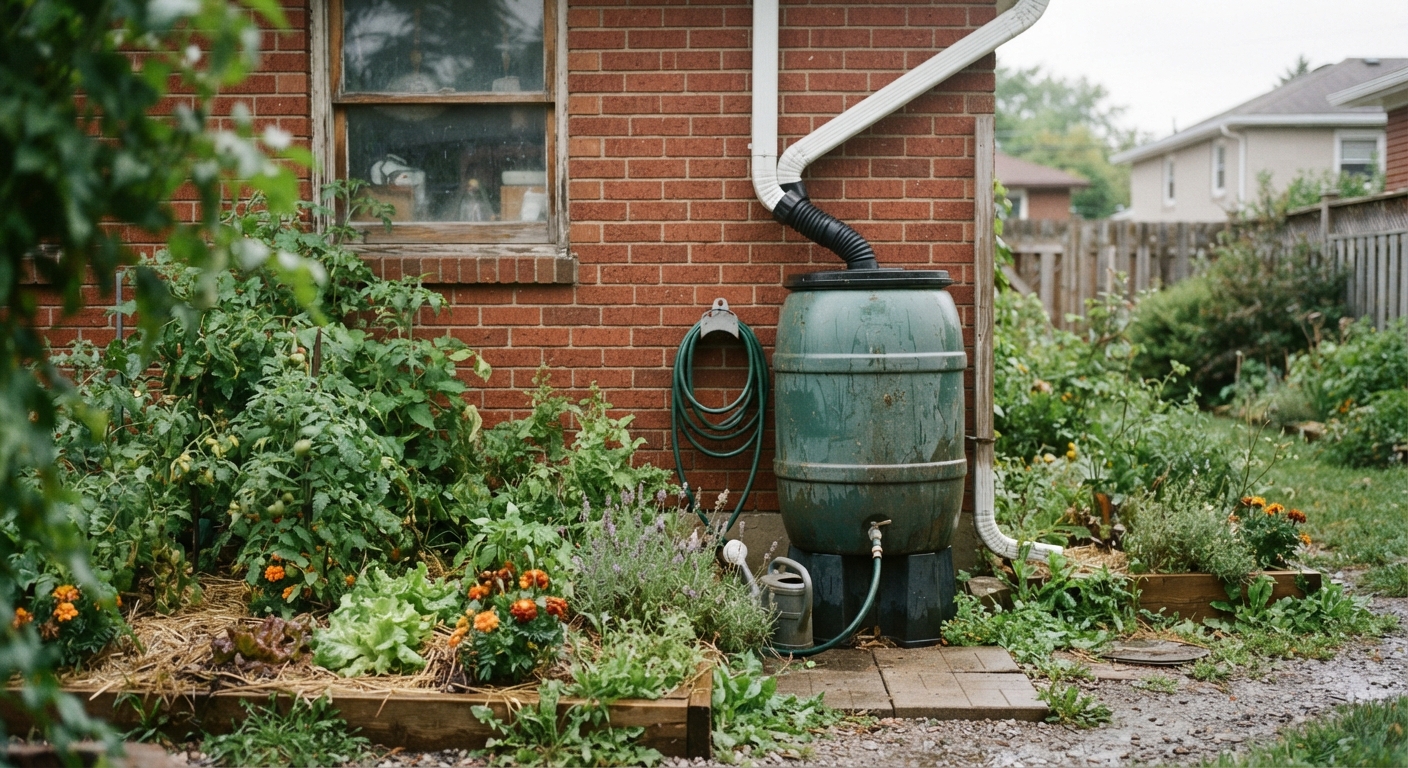
You don’t need a fancy setup to make this worthwhile. A basic system is really just three things: a container with a lid, a way to get water in from your roof or downspout, and a spigot or way to get water back out. Many hardware stores and some water utilities sell simple 40 to 55-gallon barrels designed for this, often in the $30 to $50 range, and some cities offer them at a discount or even free through conservation programs.
If you’re renting and want to keep things simple and fully portable, a large lidded storage tote or a food-grade plastic drum with a spigot installed works just as well and can sit on a patio or balcony corner without any attachment to the building at all. You just position it to catch runoff, or manually direct water into it during a storm using a section of gutter downspout or even a tarp funnel if you’re being resourceful.
As for what it actually captures: a moderate rainstorm dropping half an inch of rain over a roof section feeding one downspout can fill a 50-gallon barrel surprisingly fast, sometimes in under an hour. Even a smaller catchment area, like a covered patio roof or a shed, can net you a full barrel over a season of average rainfall. The exact number depends on your roof size and local rainfall, but the general takeaway is that one or two decent storms a month can keep a barrel in steady rotation for watering pots, garden beds, or a small patch of lawn without touching your tap at all.
Simple greywater reuse ideas that don’t require plumbing changes
Greywater usually refers to lightly used household water — from washing dishes, rinsing produce, or cooking — that can be reused for things like watering plants instead of going straight down the drain. For renters, the easiest version of this involves zero plumbing changes at all, just a shift in habit and a bucket or dishpan.
Some simple ones that add up:
Keep a dishpan in the sink when you’re rinsing produce or washing dishes by hand, and use that leftover water on outdoor plants instead of letting it go down the drain. Save the water from boiling pasta or vegetables once it cools — it’s often full of nutrients plants like anyway. Leftover ice from coolers, drink pitchers, or ice makers can be dumped on plants instead of down a sink. Water from rinsing reusable water bottles or the last bit left in glasses at the end of the day can go into a countertop container instead of the drain.
The one thing to avoid reusing on edible plants is water that’s touched grease, harsh soap, or raw meat, since that defeats the purpose and can attract pests or harm soil. But for ornamental plants, lawns, or non-edible landscaping, almost any lightly used water is fair game. None of this requires new plumbing or landlord approval, since you’re just changing where a bucket of water ends up instead of changing anything about the apartment itself.
Calculating how many gallons you’d need to divert to notice a difference on your bill
This is the part that helps you decide if it’s worth the effort before you start hauling buckets around. Water bills are typically charged per unit of usage, often measured in units of 1,000 gallons or in hundred cubic feet, and the rate varies by city and by how tiered your usage brackets are. To notice a real difference, you generally need to be diverting enough water on a consistent basis to shift you out of a usage tier, not just save a gallon here or there.
Start by pulling your last water bill and looking at your average monthly usage in gallons. If outdoor watering is a meaningful chunk of that, that’s your target. A single rain barrel refilled and used once or twice a week during watering season might offset somewhere in the range of 50 to 150 gallons of tap water a month, depending on how much you’re already watering outdoors. That’s a modest dent for most single-family water bills, but for renters with lower baseline usage, it can be a noticeably larger percentage.
The honest answer is that one barrel alone probably won’t move your bill by much in dollar terms, but it’s also nearly free to run once it’s set up, so the payback isn’t really about crossing some dramatic threshold. It’s about permanently removing a chunk of your outdoor water use from the metered side of the ledger, for the cost of a barrel and a little bit of hauling. If you’re using several barrels, or combining rain collection with the small greywater habits above, that’s when the numbers start to add up to something you’d actually notice.
When it’s not worth the effort: apartments with shared outdoor space or strict HOA rules
This whole approach depends on having some outdoor space that’s yours to use and plants that actually need watering. If you live in a unit with no balcony, no patio, and no personal garden space, there’s genuinely nothing to collect water for, and setting up a barrel just to store water with nowhere to use it isn’t worth the trouble.
Shared outdoor spaces are trickier. If your patio or yard area is common space used by multiple units, placing a barrel there can create disputes over who it belongs to, whether it’s blocking a walkway, or whether it looks fine to other tenants. It’s not necessarily against the rules, but it adds friction that may not be worth it for the amount of water you’d actually be able to use yourself.
HOA communities are often the strictest environment for this, since many have specific rules about what can be visible from a shared walkway, patio, or parking area, purely for appearance reasons rather than water rules. If your community has language banning visible storage containers or requires architectural approval for anything added to a patio, a rain barrel may fall into that category even though it has nothing to do with water policy. In these cases, the indoor greywater habits — the dishpan, the pasta water, the leftover ice — are still fair game and cost nothing to try, even if the barrel itself isn’t practical. Sometimes the smallest habit changes are the ones that actually fit your situation, even when the bigger setup doesn’t.