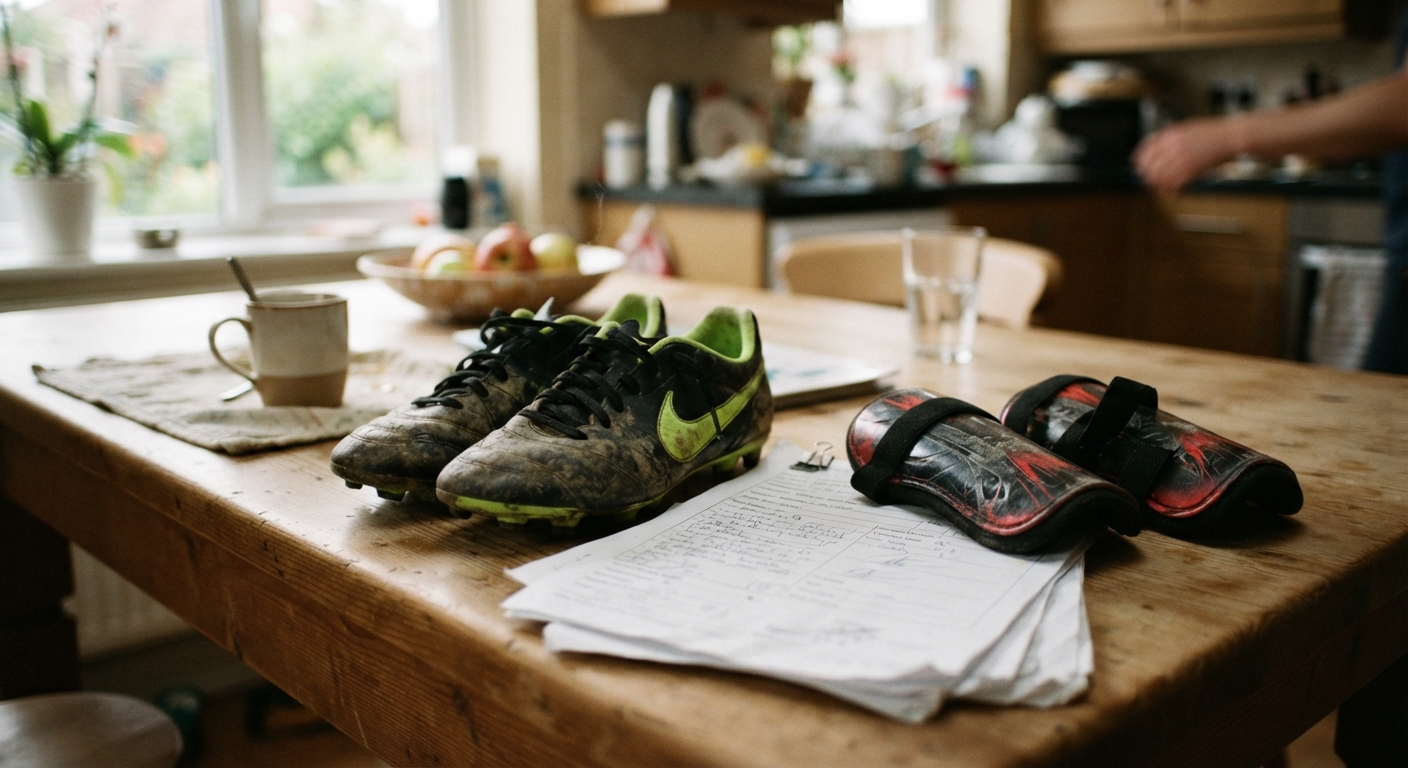
You budgeted for registration fees. You did not budget for the $80 cleats your kid outgrows by spring, the three tournament weekends that each cost you a tank of gas and a hotel night, or the “optional” team hoodie that turns out to be mandatory once everyone else has one. Youth sports has a way of hiding its real price tag behind a registration number that looked manageable back in August. By the time the season wraps up, you’ve often spent more than you did on school supplies, field trips, and class fees combined.
None of this means pulling your kid off the team. It means treating sports costs like any other recurring household expense that can be trimmed, timed, and negotiated. Here’s where the money actually goes, and where you can get some of it back.
Why sports fees often cost more than tuition-related school fees once gear and travel are added up
Registration is usually the smallest line item, not the biggest. A league might charge a flat fee that covers field time, referees, and insurance, and that number is the one parents plan around. But it rarely includes cleats, pads, a glove, a stick, practice gear, a game uniform, tournament fees, gas to away games, hotel stays for weekend tournaments, team meals, end-of-season party contributions, and the coach’s gift everyone quietly chips in for.
Add it up over a season and gear plus travel frequently outpaces the registration fee by two or three times. A $150 signup fee can easily turn into $500 or $600 once you’ve kitted out a growing kid and driven to four away games. Compare that to a school field trip fee or a classroom supply list, and sports starts looking like the more expensive extracurricular by a wide margin, even though it never gets budgeted that way.
The fix starts with treating the season as one expense with several moving parts, not a single fee you pay in August and forget about. Once you see the whole picture, it’s much easier to find where the real savings are.
Asking leagues and schools directly about fee waivers, sibling discounts, or payment plans before the season starts
Most leagues and school athletic programs have more flexibility than the sign-up form suggests. Sibling discounts are common but rarely advertised on the registration page. If you have two or three kids in the same program, ask directly whether a reduced rate applies to the second and third child. It often does, and it’s often something you have to request rather than something that gets applied automatically.
Payment plans are worth asking about too, especially for programs that charge a large fee upfront. Many leagues would rather split your payment into two or three installments than lose a player, and they’ll say yes if you ask before the season starts rather than after you’ve fallen behind. The key is timing: reach out during registration, not three weeks into the season when you’re already behind on a payment.
Fee waivers or reduced rates for families managing a tight budget also exist in a lot of community and school-based programs, even when there’s no formal application process listed anywhere. A short, direct conversation with the league treasurer, athletic director, or team parent coordinator is usually all it takes. Ask plainly: “Is there any flexibility on the fee for our family this season?” You don’t need to explain your whole financial situation. Most organizers have handled this request before and have a quiet way of accommodating it.
Where to find gently used cleats, pads, and uniforms through swap groups, resale apps, and end-of-season sales
Kids outgrow gear faster than they wear it out, which means the secondhand market for youth sports equipment is enormous and mostly untapped by families who assume they have to buy new. Local parent swap groups, whether on social media or organized through a school or league, are often the fastest way to find cleats, shin guards, helmets, and uniforms in good condition for a fraction of retail price. Many of these groups exist specifically because parents want the gear out of their garage as much as you want it off your shopping list.
Resale apps are worth a regular scroll too, particularly right after a season ends when families are offloading gear their kids have grown out of. Search by size and sport rather than brand, since youth players often outgrow equipment before it’s worn out, meaning “used” frequently means “barely used.”
End-of-season clearance sales at sporting goods stores are another reliable source, especially for uniforms, cleats, and protective gear that doesn’t need to match a specific team color. Buying a size up during a spring clearance sale for gear your kid won’t need until fall can mean paying half of what you would right before tryouts. The trade-off is storage space and a little bit of guessing on sizing, but for anything that isn’t team-branded, it’s usually worth it.
If your league or school has any kind of gear closet or loaner program for pads, helmets, or other big-ticket protective equipment, ask about it directly. These programs exist in a lot of places but don’t always get mentioned unless a parent brings it up first.
Splitting carpools and travel costs with other families for away games and tournaments
Travel is one of the sneakiest costs in youth sports because it doesn’t show up as a single fee. It shows up as gas, tolls, parking, meals on the road, and sometimes a hotel room for a weekend tournament. None of that gets billed to you in one lump sum, so it’s easy to underestimate how much a season of away games actually costs until you look back at a few months of receipts.
Carpooling isn’t just about saving gas money, though that adds up. It’s about spreading the cost of travel across several families instead of one, which matters most for the families driving the farthest or most often. Setting up a simple rotation at the start of the season, rather than scrambling to coordinate before each game, makes it much easier to stick to and much easier for other parents to say yes to.
For tournaments that require an overnight stay, look at splitting a hotel room or a rental with another family rather than each booking separately. Team parent groups often coordinate this informally, but if yours doesn’t, it’s worth being the one to suggest it. Booking as a group can also sometimes unlock a lower room rate than booking solo, particularly for tournaments where multiple teams from the same region are staying at the same handful of hotels.
If your team travels regularly, it’s also worth raising the idea of a shared travel fund at the start of the season, where families contribute a flat amount upfront that covers shared costs like a team van rental or fuel reimbursement for whoever drives the most. It’s a small amount of organizing work that pays off over months of games.
Timing equipment purchases around off-season clearance instead of buying right before tryouts
The worst time to buy sports gear is the two weeks before tryouts, when every parent in town is shopping for the same cleats and stores know it. Prices are at their highest and selection is at its most picked-over exactly when demand is highest. The best time to buy is right after a season ends, when stores are clearing out inventory to make room for the next sport’s gear.
This means buying spring sport equipment in early summer clearance, and fall sport equipment in late fall or winter clearance, well ahead of when your kid will actually need it. It requires a bit of forward planning and a decent guess at what size they’ll be in a few months, but the discount is usually significant enough to make the guesswork worth it.
For gear that isn’t size-dependent, like bags, water bottles, or non-team-specific practice wear, there’s no downside to stocking up during a clearance sale even if you’re not sure exactly when you’ll need it. For cleats and pads, buying a half size up during clearance is generally a safer bet than buying true-to-size right before tryouts, since most kids grow into gear faster than out of it.
If you know your child is committed to a sport year over year, keeping a small running list of what wore out or was outgrown at the end of each season makes off-season shopping much faster and more targeted the next time a clearance sale rolls around.
When it makes sense to ask a coach about a reduced or deferred fee versus sitting a season out
Sometimes, even after trimming gear costs and splitting travel, the fee itself is the sticking point. This is worth raising directly with a coach or team manager rather than assuming the only options are paying in full or not playing at all.
Coaches and team organizers generally want kids on the field more than they want a perfectly balanced budget, and many have quietly worked out reduced or deferred payment arrangements for families before. A short, straightforward conversation, ideally before the season starts rather than after fees are already overdue, is usually well received. Something like asking whether the fee could be paid in two installments, or whether a partial scholarship or reduced rate exists, opens the door without requiring you to over-explain your situation.
Sitting a season out is sometimes the right call, particularly if travel and gear costs would stack on top of a fee you’re already stretching to cover. But it’s worth exhausting the direct conversation first, since a lot of families sit out seasons unnecessarily simply because they never asked. Coaches would generally rather work something out than lose a player, and league organizers would rather fill a roster spot than leave it empty.
If a reduced fee genuinely isn’t available and the season isn’t financially workable this time around, it’s fair to be upfront about it and ask what the path back looks like for next season, whether that’s an early registration discount, a payment plan set up in advance, or simply making sure you’re first in line to ask when the next season’s fees are announced.