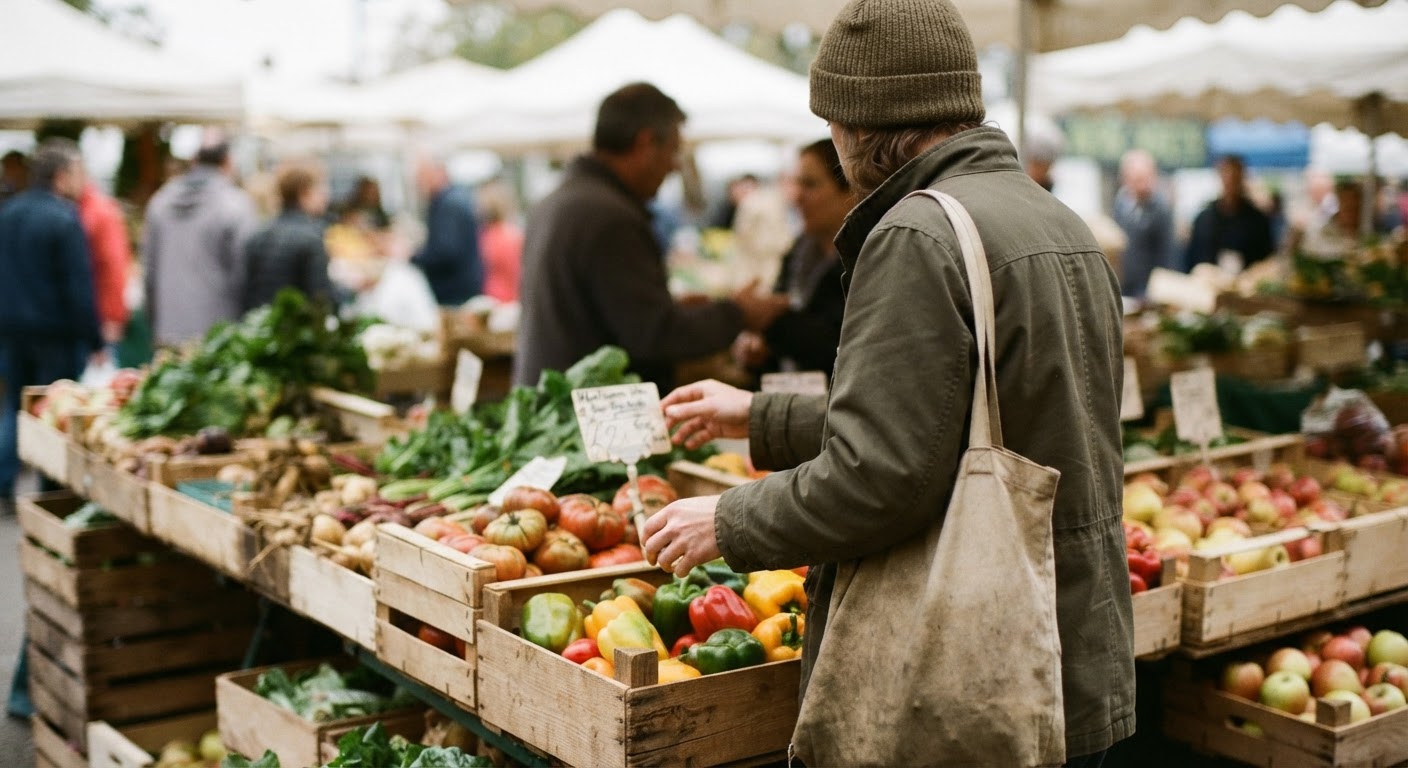
Farmers markets have a reputation for being the place you go when money isn’t the main concern — pretty baskets, chalkboard signs, prices that make you wince a little. And sometimes that reputation is earned. But it’s not the whole story. Depending on the season, the item, and where you shop, local produce can undercut the grocery store by a noticeable margin. The trick is knowing when, and that means doing a little math instead of relying on gut feeling.
How to compare per-pound pricing between markets and grocery stores
The biggest mistake people make when comparing a farmers market to a grocery store is comparing totals instead of unit prices. A pint of strawberries at a market stand might look expensive next to a grocery store clamshell, until you weigh both and realize the market pint has twice the fruit and none of the plastic padding at the bottom.
Before you go, it helps to know your grocery store’s regular (non-sale) price per pound for the handful of items you buy most — tomatoes, onions, apples, leafy greens, whatever shows up in your cart every week. Write these numbers down or keep them in your phone. Grocery stores rotate sales constantly, so compare against the regular shelf price, not last week’s discount, or you’ll end up thinking local is more expensive than it actually is relative to what you’d normally pay.
At the market, do the same conversion. Vendors often sell by the pint, bunch, or “basket,” not by the pound, so ask. Most farmers are used to the question and will tell you straight away, or you can eyeball it against a produce bag from home if you’re shy about asking. Bunches of greens and herbs are where this matters most — a bunch of kale at a stand can be genuinely double the size of a grocery store bunch for the same price, which changes the comparison completely even though the sticker price looks identical.
Also factor in what you’re not paying for. Grocery store produce carries the cost of refrigerated trucking, packaging, and a retail markup layered on top of what the farm actually earned. Market produce skips most of that. It doesn’t always mean a lower price, but it means the price you’re paying is going almost entirely toward the food itself, which is worth noting when a stand’s price and a store’s price land close to even — you’re getting more for the same money even when the numbers tie.
Season-by-season price swings that favor farmers markets
Local produce pricing isn’t flat throughout the year, and this is where farmers markets can genuinely beat grocery stores rather than just competing with them.
In peak season — deep summer for tomatoes, corn, peppers, stone fruit; early fall for apples, squash, and greens — farmers are often sitting on more of a crop than they can move, and prices drop accordingly. A grocery store’s price for a tomato barely moves whether it’s July or January, because it’s sourcing from wherever in the country or world it’s currently in season, plus the transportation cost of getting it to you. A local tomato in July, grown twenty miles away and picked that morning, has none of that overhead. This is the window where you’ll see the biggest gap in the market’s favor, sometimes by half or more on things like tomatoes, peppers, summer squash, and berries.
Shoulder seasons are murkier. In early spring or late fall, farmers markets are thinner, vendors have less volume, and prices can actually sit above grocery store prices because supply is tight and what’s available (early greens, root vegetables held over from storage) is being sold at a premium. This is the time of year to be more selective and price-check rather than assume the market is automatically the better deal.
Winter is the toughest stretch for market savings in most climates. Markets either shrink to a handful of hardy vendors selling stored roots, preserves, and hothouse greens, or close for the season entirely. Grocery stores, meanwhile, are pulling from national and international supply chains built for exactly this problem, so their prices stay more stable. If your market runs year-round, expect winter selections to be smaller and pricier per item than summer, even if still reasonable.
The practical takeaway: treat farmers markets as a strong money-saving option in peak growing season, a mixed bag in shoulder seasons worth checking item by item, and generally not your primary grocery source in deep winter unless a specific vendor’s price beats the store on something you already checked.
What a CSA box really costs once you account for waste and variety
A CSA (community supported agriculture) box is a flat weekly or biweekly fee paid upfront for a share of a farm’s harvest, delivered or picked up regardless of what’s actually in season that week. On paper, the per-pound math often looks fantastic — divide the box cost by the weight of produce inside, and it frequently beats grocery store prices, sometimes by a wide margin.
But that math only holds if you eat everything in the box, and this is where CSA savings quietly disappear for a lot of households. A box you didn’t choose the contents of will occasionally hand you three bunches of a vegetable your family doesn’t love, or a pound of something you don’t know how to cook, or more of one item than you can use before it goes soft. Every part of that box that ends up in the compost or trash is money that didn’t actually save you anything — it just moved the waste from the grocery store’s shelf to your kitchen.
Before judging a CSA as a good or bad deal, track one full box for a couple of weeks. Weigh or estimate what you actually used versus what you tossed or gave away. If you’re using close to all of it, the savings are likely real and often significant, especially compared to buying the same variety of items individually at retail. If a third or more consistently goes unused, the “deal” is smaller than the sticker price suggests, and you should adjust your estimate of the real per-pound cost accordingly — divide the box price by what you actually ate, not what was delivered.
Variety matters here too, in both directions. A CSA exposes you to vegetables you might not normally buy, which can be a genuine value if it expands what your household eats and reduces how much you’re buying elsewhere. It can also be a hidden cost if it pushes you into buying separate ingredients to cook unfamiliar produce, or if you end up buying your normal groceries anyway because the box doesn’t cover staples like proteins, dairy, or pantry basics. A CSA rarely replaces a grocery trip outright — it supplements it — so the fairest comparison is the box price against what you would have spent on that same volume and mix of produce at the store, not against your entire grocery bill.
Some farms offer smaller box sizes or every-other-week pickups specifically for smaller households. If a full weekly box consistently produces waste, downsizing the share size or frequency is usually the better fix rather than dropping the CSA altogether, since a smaller box you fully use will almost always beat a large one you partially waste.
Buying co-op memberships: fees versus real savings over a year
Food co-ops work differently from farmers markets and CSAs. You typically pay a one-time or annual membership fee, and in exchange you get access to member pricing, which is usually a percentage off regular shelf prices, sometimes with additional sales or discount days for members only.
The membership fee is the easy part of the math — it’s usually a fixed, known number. The harder part is estimating whether your annual savings from member discounts will exceed that fee, and that depends entirely on how much you actually shop there and what you buy.
A rough way to estimate this: take your average grocery spending on the kinds of items the co-op specializes in (often produce, bulk grains, dairy, and pantry staples) and multiply by the member discount percentage. If that projected annual savings clears the membership fee within the first few months of the year, it’s a good deal even if you only shop there occasionally after that. If it takes the full year to break even, it’s a much closer call, and worth asking whether the co-op offers a trial period or lower-cost associate membership before committing to full membership pricing.
Co-ops also tend to be strongest for bulk staples — dried beans, rice, oats, flour, nuts — bought by weight from bins rather than pre-packaged. This is often where the real savings live, more than in the produce aisle, because bulk bins cut out packaging costs almost entirely and let you buy exactly the amount you need. If your household already cooks a lot from scratch with these staples, a co-op membership tends to pay for itself faster than if your spending is mostly on packaged and prepared foods, which co-ops don’t always price more competitively than a regular grocery store.
Some co-ops also offer working member discounts, where a few hours of volunteer time per month earns a deeper discount than the membership fee alone provides. If your schedule has room for it, this is often the fastest way to make membership clearly worth it, since the “cost” is time rather than money.
Simple rules for deciding week to week where to shop
You don’t need to run a full cost analysis every week. A few standing rules can guide most decisions once you’ve done the initial homework above.
Buy in-season produce at the farmers market or through a co-op’s bulk bins when the item is at peak local harvest — this is reliably where the biggest gap in your favor shows up. Buy out-of-season produce, packaged goods, proteins, and pantry staples at the grocery store, where national supply chains keep prices steadier year-round regardless of local growing conditions.
If you’re in a CSA, plan your weekly grocery list around what’s likely to be in the box rather than shopping first and adjusting later — this cuts down on the overlap that leads to waste and wasted money. Check the farm’s typical harvest calendar if they publish one, so you’re not caught off guard by four straight weeks of the same green.
When a market vendor’s price and the grocery store’s regular price are close, lean toward the market. You’re getting fresher produce, usually with less packaging, and supporting a business that isn’t marking the price up as many times before it reaches you — a genuine value even when the dollar difference is small.
Finally, revisit your comparison numbers a couple of times a year, not just once. Prices shift with the seasons on both sides — grocery store sales rotate, and market pricing swings from peak-season deals to shoulder-season premiums. A comparison that told you the market was cheaper in July won’t necessarily hold true in November, and treating your grocery budget as something to check in on periodically, rather than something you set once and forget, is what actually keeps these small savings adding up over the year.