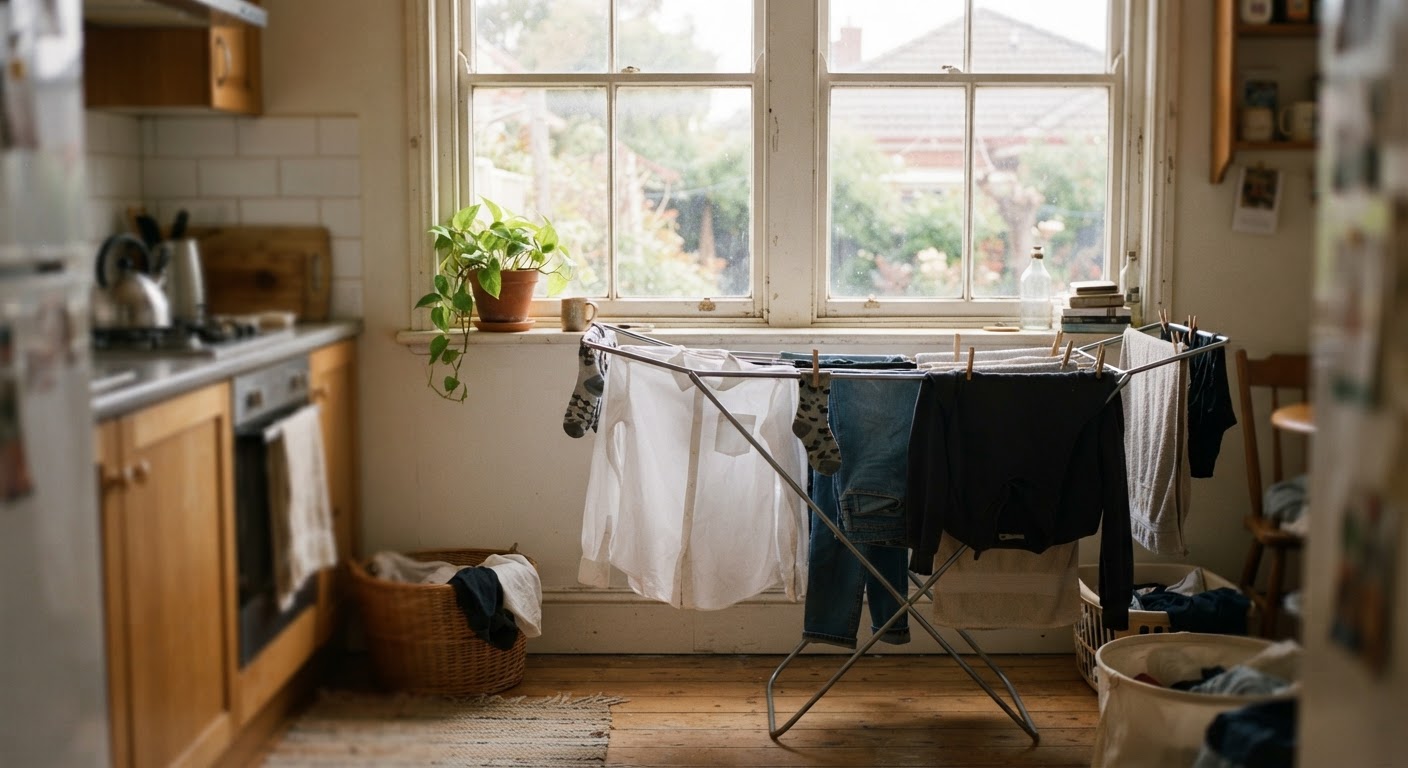
Your dryer is quietly one of the most expensive appliances you own to run. Not to buy — to run, every single week, month after month. Most people know this in the abstract, the way you know kale is good for you, but they never quite get around to doing anything about it because the payoff feels murky. Is line drying actually worth the hassle? The honest answer is: it depends on the season, your humidity, and how much your time is worth to you that particular week. Let’s break it down properly.
How much a typical dryer cycle actually costs in electricity or gas
A standard electric dryer pulls a serious amount of power for the 40 to 60 minutes it runs — it’s one of the few household appliances that draws close to its maximum rated wattage the entire time it’s on, because it’s essentially a giant heating element with a motor attached. Gas dryers use less electricity but still draw power for the drum motor, the tumbling action, and the moisture sensor, plus the cost of the gas itself.
The exact cost of a single cycle varies by your local utility rates, your dryer’s age and efficiency, and how full the load is (a stuffed drum takes longer to dry than a properly loaded one, which sounds counterintuitive but is true — air needs room to circulate). What matters more than the exact number is the pattern: dryers are a recurring, predictable, largely avoidable cost. Unlike your fridge, which runs whether you want it to or not, the dryer is a choice you make every time you do laundry. That’s exactly why it’s worth paying attention to. A cost you control is a cost you can actually shrink.
If you run a load of laundry every couple of days, that’s somewhere around ten to fifteen dryer cycles a month for an average household. Multiply whatever your dryer costs per cycle by that number and you start to see why this is one of the higher-leverage places to make a change — not because any single cycle is expensive, but because you’re doing it so often.
Why humidity and season change the real value of line drying
Here’s the part that gets left out of most “just hang your clothes up” advice: air-drying isn’t a fixed win. Its value swings hard with the weather, and pretending otherwise is how people end up disappointed and give up on the whole idea.
In a dry summer, whether outdoors on a line or indoors near an open window with a fan going, clothes can dry in a couple of hours. You’re getting nearly the full benefit of skipping the dryer with almost none of the downside — no long wait, no musty smell, no damp house. This is the season to lean into line drying hard.
Winter is the opposite story in a lot of climates. Cold outdoor air holds very little moisture, which sounds like it should help drying but actually just means clothes freeze before they dry, or they take so long outside that it’s not practical. Indoors, winter heating systems often make the air quite dry, which can actually help drying racks work faster than you’d expect — but if you live somewhere humid and cold, indoor drying in winter can take the better part of a day, and hanging six loads a week can leave your bedroom or bathroom feeling damp and smelling faintly of wet laundry.
Spring and fall are the wildcard seasons. Rain, humidity swings, and unpredictable temperatures mean the value of the clothesline changes week to week. This is when a lot of people either overcommit (hanging a full load outside and getting rained on) or undercommit (running the dryer out of habit on a day that was actually perfect for line drying). Checking the forecast for a couple of dry, breezy hours is a five-second habit that pays off disproportionately in these transitional months.
The bigger point: don’t treat air-drying as an all-or-nothing lifestyle change. Treat it as a seasonal dial you turn up or down depending on what the air is actually doing that week.
Indoor drying racks vs outdoor lines: space, time, and wear on clothes
Assuming you have any kind of yard, patio, or balcony access, an outdoor line dries clothes faster than an indoor rack almost every time, because moving air and sunlight both speed up evaporation. It’s also free after the one-time cost of a line or a couple of collapsible racks, and sunlight has a mild bleaching and disinfecting effect that’s genuinely useful for towels, cloth diapers, and anything that tends to get musty.
The tradeoffs are real, though. Outdoor drying means checking the weather, timing loads around when you’ll actually be home to bring things in, and accepting that pollen, dust, or a passing rain shower can undo an afternoon’s work. Dark clothes fade faster in direct sun over time, so if you’ve got work clothes or anything you care about keeping sharp-looking, inside-out is a good habit, or reserve the line mainly for whites, towels, sheets, and kids’ clothes that are going to get worn out anyway.
Indoor racks solve the weather problem entirely but introduce a space problem. A full rack of laundry can take up a meaningful chunk of a bedroom or living room for half a day, which is a real cost if you’re in a small apartment. Airflow matters more indoors than people expect — a rack shoved into a closet or a corner with no air movement can take twice as long to dry as one near a window, a fan, or a heating vent. A cheap box fan pointed at a drying rack is one of the best-value purchases in this whole category; it can cut indoor drying time dramatically for pennies of electricity compared to what a dryer would cost for the same load.
On wear and tear: this is actually where air-drying wins outright, regardless of season. Dryer heat and tumbling are hard on elastic, on printed graphics, on delicate fabric, and on anything with buttons or embellishments. Kids’ clothes with waistbands and school uniforms with any stretch to them last noticeably longer when they’re air-dried instead of machine-dried cycle after cycle. If you’re buying school clothes or uniforms that need to last a whole year, keeping them off the dryer is one of the more reliable ways to stretch that budget further, on top of whatever you’re saving on the electric bill.
A simple weekly rotation that cuts dryer use without adding hours of hassle
The households that stick with air-drying long-term almost never do “all laundry, all the time, on the line.” They pick a rotation that fits their actual week and their actual space, and they let the dryer fill in the gaps. Here’s a version that works for a lot of families without requiring a lifestyle overhaul.
Start by splitting your laundry into three rough categories: things that dry fast and don’t mind hanging (t-shirts, kids’ clothes, underwear, socks), things that are bulky and slow (towels, sheets, jeans), and things you genuinely need dried quickly because you’re wearing them tomorrow. The first category is your easiest win — hang it any day, any season, indoors or out, and you’ll barely notice the difference in your routine.
For the bulky category, pick your best drying days — sunny and breezy outside, or a day you’re home with a fan running indoors — and batch your towels and sheets together on those days specifically, rather than washing them whenever and hoping the weather cooperates. Towels and sheets are also the loads that eat the most dryer time and cost the most per cycle, so shifting even two of these loads a week off the dryer adds up faster than shifting five loads of light clothing.
For the “need it tomorrow” category, this is where the dryer earns its place. Don’t fight this. A five-minute “fluff and finish” cycle after a load has mostly air-dried uses far less energy than drying the whole load from soaking wet, and it solves the stiffness that fully line-dried towels sometimes get.
A workable rhythm looks something like this: hang the light, fast-drying stuff every time, regardless of season. Reserve two “big load” air-drying sessions a week for towels and sheets, timed to your best weather or your best indoor airflow days. Let the dryer handle anything urgent, anything wool or delicate that needs its own care anyway, and anything on a stretch of bad weather where hanging clothes would just mean a house full of damp laundry for two days. This isn’t a purity test. It’s a rotation designed to survive a busy week, which is the only kind that actually lasts.
When paying for the dryer cycle is actually the smarter trade-off
There are weeks and situations where running the dryer is genuinely the better call, and it’s worth saying so plainly instead of pretending air-drying is always the virtuous choice.
If you’re sick, if you’re juggling a newborn’s laundry on top of everyone else’s, or if you’re in the middle of a stretch with no childcare backup and no spare hour to manage a drying rack, the dryer buys you time you don’t have to spare. That trade is worth making. The whole point of trimming a recurring bill is to give yourself breathing room, not to create a new source of stress every laundry day.
Similarly, in a stretch of humid, rainy weather with no good indoor airflow, forcing an air-dry can leave you with laundry that smells musty or, worse, starts to mildew before it fully dries. That outcome costs you more in wasted detergent, rewashing, and ruined clothes than the dryer cycle would have. When in doubt, the smell test is a good one: if a load has been drying for over a day and still smells damp rather than clean, it’s time to finish it in the dryer rather than wait it out.
Bedding for a household member with allergies, delicate items with drying instructions that specifically call for tumble-dry-low, and anything you need in the next hour are all reasonable exceptions too. The goal isn’t zero dryer use. It’s using the dryer on purpose, for the loads and the weeks where it’s actually earning its cost, instead of on autopilot for every load regardless of season. That shift alone — from automatic to intentional — is where most of the monthly savings actually come from.