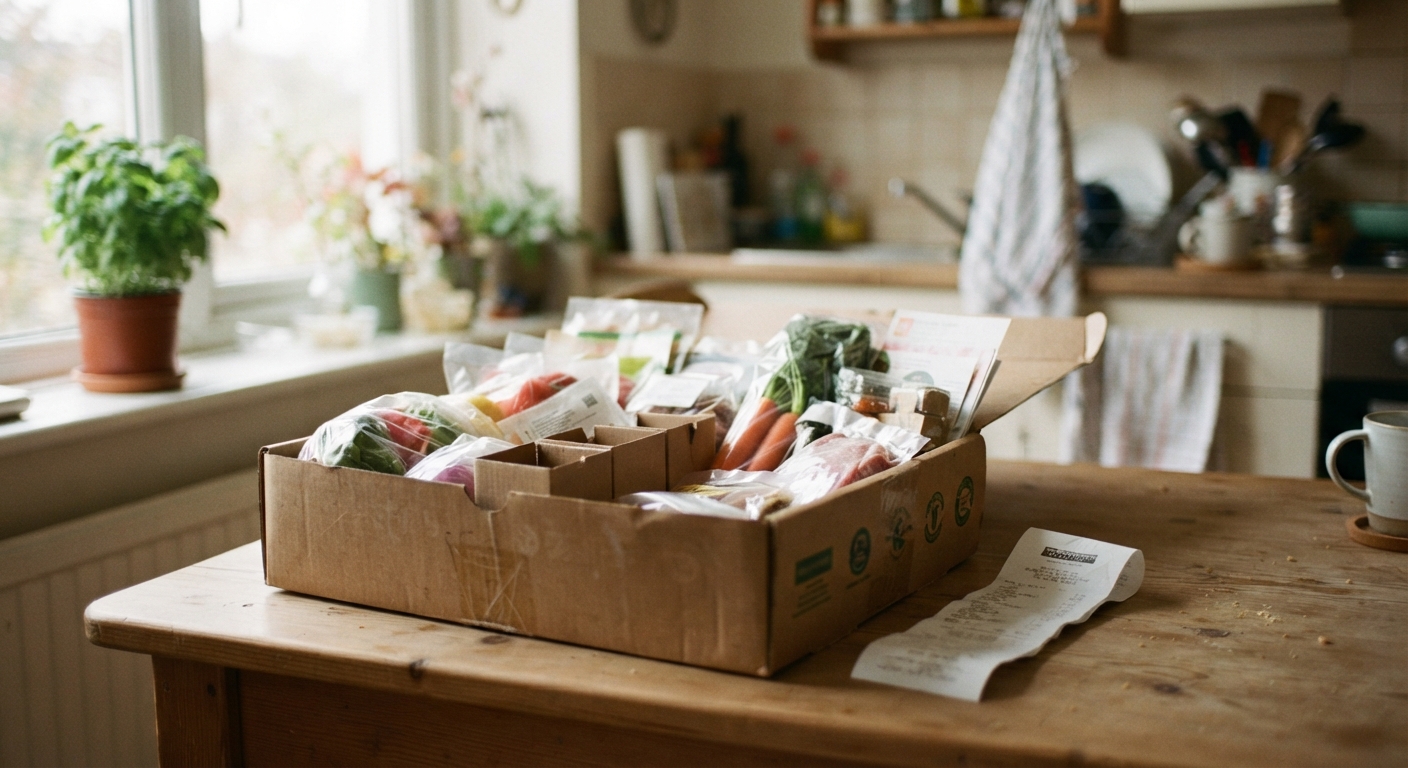
Why subscription pricing looks cheaper on the landing page than it is on your bank statement
Every meal kit and snack box ad is built around one number: the price per serving, usually somewhere between $8 and $12, printed in big friendly letters right under a photo of food that looks better than anything you’ve cooked all week. That number is real. It’s also almost never the number that shows up on your bank statement.
Here’s what usually happens between the landing page and checkout. The advertised price often applies only to your first box, or only if you order the maximum number of servings, or only if you skip the “premium” meals that cost $4 more each and somehow make up half the menu. Shipping gets added at checkout, sometimes labeled a “handling fee,” sometimes just folded in without much explanation. If you’re using a snack or grocery box that includes delivery drivers, a tip gets suggested before you even see your total, and most people click the default rather than doing the math.
Then there’s the plan itself. Most of these services are built around a subscription model, not a one-time purchase, which means the price you saw is really a price for committing to recurring boxes. Skip a week and some services still charge a small fee or shrink your discount. Forget to skip, and you’re charged for a box you didn’t want, sitting on your porch getting warm.
None of this makes these services scams. It means the sticker price is doing a lot of work to make the product look leaner than it is, and the real cost only becomes visible once you add up a full month of charges, not one showcase order. If you’ve ever looked at your bank statement and thought “wait, why was that $94,” you’ve already met this gap in person.
How to calculate true cost per serving including shipping, tips, and food waste
The fix for sticker-price confusion is a five-minute math exercise you only need to do once per subscription, and then again anytime the pricing changes.
Start with your actual charge for the month, not the number on the ad. Pull it straight from your bank or credit card statement. Include shipping, any tip you added, and any “convenience” or “handling” fee tacked on separately from the food cost.
Next, count servings you actually ate, not servings you were charged for. This is the step people skip, and it’s the one that matters most. If your box came with ingredients for four dinners at two servings each, that’s eight servings on paper. But if one meal went bad before you got to it, or a kid refused to eat their portion and you tossed it, or you doubled up and ate two servings in one sitting because you were hungry and it was there, your real number is lower than the box promised.
Divide your total monthly charge by your real servings eaten. That’s your true cost per serving. Now compare it to what the same meal would cost from a regular grocery trip. A rough but fair way to do this: price out the same core ingredients, chicken, a vegetable, a starch, a sauce base, at your regular grocery store, and divide by how many servings that would realistically make. You don’t need to be exact. You need to be honest.
Most families who run this calculation find their meal kit costs land somewhere between two and four times what the same meal would cost made from a grocery list. That gap isn’t automatically a problem. You’re paying for someone else to plan the meal, portion the ingredients, and hand you a recipe card so you don’t have to think about dinner at 5:45pm with a toddler pulling on your leg. That convenience has real value. The question is whether it has more value to you than the dollar difference, and you can’t answer that honestly without doing the division first.
The subscriptions that genuinely save money for specific households (and why)
It’s worth saying plainly: some grocery and meal subscriptions are a genuinely good deal for certain households, not despite the math but because of it.
Households that were reliably ordering takeout two or three times a week are the clearest case. If your realistic alternative to a $9-per-serving meal kit is a $16 delivery order with a service fee and a tip on top, the meal kit wins on cost every time, and it usually wins on nutrition too. The comparison that matters isn’t meal kit versus homemade from scratch, it’s meal kit versus what you were actually doing before you subscribed.
Bulk pantry and household-goods subscriptions, the kind that auto-ship things like diapers, formula, coffee, or paper products on a schedule, tend to save money for a different reason: they lock in a discount for items you were always going to buy anyway, at a quantity you were always going to use. There’s no food waste risk because these aren’t perishable, and there’s no “did I actually cook this” gap between what you’re charged for and what you use. If the per-unit price beats your regular store, and you have somewhere to store bulk shipments, this category is close to a pure win.
Snack and lunch-box subscriptions can work well for households with picky eaters who otherwise waste a lot of food buying variety packs at the store and having half of them go stale in the pantry. If the subscription is genuinely introducing your kid to snacks they’ll eat, and doing it at a price close to grocery store snack aisle pricing, the convenience of not standing in that aisle every week has real value.
The common thread in all three cases isn’t the type of subscription, it’s that the household’s actual behavior without the subscription would have cost as much or more. That’s the test that matters, and it’s specific to your household, not a general rule about meal kits being good or bad.
Red flags that mean you’re paying for convenience you don’t use
The flip side is just as specific. A few patterns show up over and over in households where a subscription has quietly stopped earning its keep.
The first is a growing gap between boxes ordered and boxes fully used. If you’re skipping weeks often, or boxes are sitting unopened for two or three days before you touch them, you’re paying for a service you’re not actually leaning on. The convenience only has value if you use it close to when it arrives.
The second is compensating cooking. This shows up when you find yourself needing to buy extra groceries anyway, an extra vegetable because the portion looked thin, bread because the meal didn’t feel complete, something for breakfast and lunch because the box only covers dinner. When that happens, you’re not replacing a grocery trip, you’re adding an expensive add-on to one.
The third is portion mismatch. Boxes built around adult servings often don’t map cleanly onto a household with young kids who eat less, or a mixed household where teenagers eat more. If you’re regularly having to supplement a “two serving” meal to feed three people, or throwing away a third of a “family size” box because it’s too much, the per-serving math the company advertised was never your household’s real math.
The fourth is stacking. It’s easy to end up with a meal kit, a snack box, and a coffee subscription all running at once, each one individually justifiable, together adding up to a real chunk of the grocery budget without you ever having tallied it in one place. If you can’t say off the top of your head how many food-related subscriptions you’re currently paying for, that’s worth finding out before doing anything else on this list.
None of these red flags mean the subscription is a bad product. They mean it’s a mismatch for how your household actually eats right now, which can change month to month as kids grow, schedules shift, or a season gets busier or slower.
A simple month-long test to decide whether to keep, pause, or cancel
You don’t need to make a permanent decision today. A one-month test gives you real data instead of a guess, and most services let you pause rather than fully cancel, which makes this low-risk to try.
Week one, keep the subscription running as normal, but start a simple log. A sticky note on the fridge or a note on your phone works fine. Every time a box or delivery arrives, write down what came in it, and over the next few days, write down what actually got eaten versus what got tossed or is still sitting there.
Week two, do the same log, but also write down what you spent on any grocery trips or takeout that supplemented the box. This catches the compensating-cooking problem before it hides in a different budget line.
By the end of two weeks you’ll have enough to run the true-cost-per-serving math from earlier in this piece using your own real numbers instead of estimates. If the number comes back reasonable for the convenience you’re getting, keep going and check again in a few months, since portion needs and schedules shift.
If the number is higher than you’d like but you’re not ready to fully give it up, pause it for two weeks and pay closer attention to what you actually do for dinner in that gap. Some households find they cook more and enjoy it. Others find they slide straight into takeout, which tells you the subscription was quietly saving you money after all, just not in the way its marketing claimed.
If you pause it and don’t miss it, don’t rush to restart it “just in case.” Subscriptions are easy to resume the moment you actually want them back, and there’s no loyalty discount for staying enrolled through months you’re not using it well. The goal isn’t to cancel every convenience in your life. It’s to keep the ones that are actually convenient for your household, at a price that matches what you’re getting, and let the rest go without guilt.