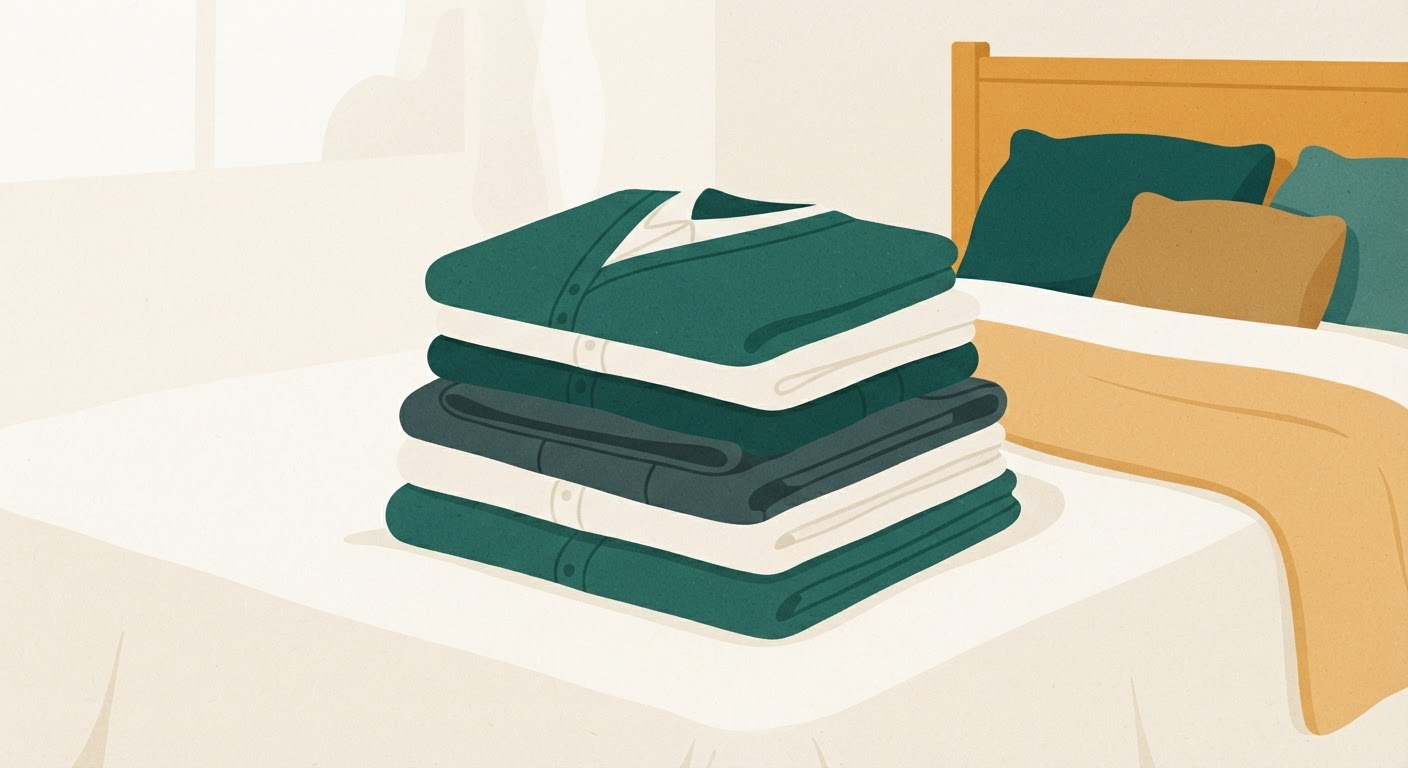
Uniforms feel like a one-time cost until you actually live with them for a school year. You buy everything new in August, feeling good about being prepared, and by November your kid has grown out of the pants. By February, the polos have gone thin at the elbows and the “permanent” crease in the pants isn’t so permanent anymore. Then spring brings another growth spurt, and suddenly you’re buying uniform pieces three or four times in a single school year instead of once.
This is the part nobody warns you about: uniform costs aren’t really an annual expense. They’re a recurring one, tucked inside your bigger back-to-school budget where it’s easy to lose track of how much you’re actually spending. A pair of uniform pants here, a new sweater there, replacement gym shoes because the old ones don’t fit the dress code anymore — it adds up fast, and it rarely shows up as one line item you can plan around.
Kids also don’t grow on a schedule that matches the school calendar. A growth spurt in October means new pants in October, whether or not that’s convenient for your budget. And uniform pieces wear out unevenly — the knees go before the waistband does, the collar frays before the rest of the shirt shows any wear. So you’re not just replacing for size, you’re replacing for condition, and those two things rarely line up neatly enough to buy everything once and be done.
The good news is that once you see the pattern — new sizes needed a few times a year, plus general wear — you can build a system around it instead of getting caught off guard every time. That system usually involves other families, not just retail stores, which is where the real savings start.
Where school uniform swap programs and closets already exist (and how to ask if yours doesn’t)
A lot of schools already have some version of a uniform closet, and a lot of parents have no idea it exists because it’s never advertised outside of a mention in a back-to-school newsletter nobody reads in full. It’s worth asking directly — call the front office or email the PTA and ask if there’s a uniform exchange, closet, or swap program, even an informal one where teachers or staff quietly keep a bin of outgrown clothes for families who need them.
These programs work because uniforms are, by design, identical across a whole school. A shirt your daughter outgrew is exactly what someone else’s daughter needs right now, in the size your daughter is about to grow into. That’s a rare kind of match in secondhand clothing, and schools are sitting on more of this supply than most families realize, mostly because families default to buying new instead of donating or swapping when their kids outgrow things.
If your school doesn’t have anything formal, you can start small without making it a big production. A shared bin near the front office, a sign-up sheet in a group chat, or a seasonal swap table at pickup can work just as well as an official program. The key is making it normal to hand off outgrown pieces instead of quietly tossing them or letting them sit in a closet. Most parents are relieved to have somewhere to put clothes their kids have outgrown, and just as relieved to find a bigger size without paying full price for it.
If you’re the one asking the school to start something, frame it as low-effort for staff — you’re not asking them to run a store, just to designate a bin and let families sort it out among themselves. Schools are generally receptive to this because it solves a problem for a lot of families at once, not just yours, and it costs the school almost nothing to host.
Buying secondhand without it feeling like a downgrade: resale groups, thrift timing, and end-of-year sales
There’s sometimes a hesitation around secondhand uniforms — a worry that it looks like you couldn’t afford new, or that your kid will notice and feel singled out. In practice, uniform pieces are one of the easiest things to buy secondhand precisely because they’re standardized. Nobody can tell a polo shirt is secondhand if it’s the right color, the right logo, and in good shape. There’s no style or trend to give it away, which is the opposite of hand-me-down sneakers or last season’s jacket.
Local resale groups — the kind organized around a specific school or district on social media — tend to be the best source because the sizing and style match exactly what your child needs, and turnover is fast at the start and end of each school year. Parents list a bag of outgrown pieces, other parents grab what fits, and prices are usually a fraction of retail because everyone in the group understands the pieces are going to be outgrown again soon anyway.
Thrift stores are hit or miss for uniforms specifically, but timing matters a lot. The best stretch is usually late spring through early summer, when families are cleaning out closets before the next school year and donating whatever no longer fits. If your store organizes by season, ask staff when uniform-style items tend to come in — some can tell you from experience even if there’s no dedicated section.
End-of-year clearance sales, sometimes run directly by uniform suppliers or school-affiliated stores, are another underused option. Retailers often discount current-year stock heavily once a new school year’s ordering window opens, because they’d rather move it than store it. If you know roughly what size your child will be in the fall, buying a size up during a spring or summer clearance can cover you for the next year at a much lower price than buying at full price in August.
The mental shift that helps most is thinking of uniform pieces as functional, not personal. Nobody develops sentimental attachment to a pair of uniform pants. What matters is that they fit, they meet the dress code, and they last — and secondhand pieces do all three just as well as new ones, usually at half the cost or less.
How to extend the life of what you already have with simple repairs and sizing tricks
Before replacing anything, it’s worth asking whether what you already have can be stretched a little further. A lot of uniform wear is fixable with basic mending — a patch on the knee, reinforced stitching on a seam that’s starting to pull, a button replaced before it’s lost entirely. None of this requires sewing skill beyond what you can pick up from a five-minute video, and a small sewing kit costs less than a single replacement shirt.
Sizing is where a little planning goes a long way. Elastic waistbands can often be adjusted rather than replaced outright — a simple hem or an added button extender can buy another few months of wear when the waist is the only thing that’s gotten tight. Pants that are a little short can sometimes be let down at the hem if there’s extra fabric folded under, which is worth checking before assuming they’re done. Skirts and shorts with adjustable waistbands are worth seeking out specifically when buying new, because they flex with growth spurts instead of getting outgrown at a fixed point.
Buying slightly ahead of size, when you can, is another way to stretch the calendar. A shirt that’s a little roomy in September usually fits well by December and still has room by spring, whereas a shirt bought to fit perfectly in September is often tight by Thanksgiving. This isn’t about buying oversized on purpose — just erring a size up when a growth spurt seems likely, rather than sizing exactly to the current measurement.
Rotating pieces also matters more than people expect. If a child wears the same two shirts every week because those are the “good” ones, those two shirts wear out twice as fast as they would if all five uniform shirts were rotated evenly. Doing a quick check every couple of weeks — pulling worn pieces to the back of the drawer, moving fresher ones to the front — spreads wear evenly and quietly extends how long the whole set lasts before anything needs replacing.
None of this is dramatic, but small maintenance habits add up to real months of extra wear across a whole uniform wardrobe, which means fewer replacement purchases over the course of a year.
Talking to the school about hardship exceptions or relaxed dress code enforcement
Some schools have more flexibility built into their dress code than families realize, and it’s worth asking about directly rather than assuming the policy is rigid. This isn’t about asking for charity — it’s about understanding what’s actually enforced day to day versus what’s written in the handbook but rarely checked.
A conversation with a teacher or school administrator can clarify a lot. Some schools allow close color matches instead of requiring the exact branded item, especially for basics like polo shirts or plain pants that don’t have a school logo. Others are lenient about minor wear — a faded shirt or slightly mismatched sweater — as long as the overall look is presentable and the child isn’t out of dress code in an obvious way. Knowing where the actual flexibility is can save you from replacing something that would have been fine as-is.
If your family is stretching to keep up with uniform costs across multiple growth spurts in a year, it’s reasonable to ask the school directly whether there’s any accommodation — a longer grace period before enforcing a new size, a temporary pass on a specific item while you source a replacement, or simply confirmation that a close substitute is acceptable in the meantime. Most schools would rather work with a family proactively than have a child sent home or singled out over a uniform issue that’s genuinely about timing, not effort.
The families who navigate this most smoothly tend to treat it as an ongoing conversation rather than a single ask. A quick note to a teacher at the start of the year — something like letting them know you’re managing uniforms as your child grows and may need a little flexibility on timing — sets expectations early and makes any later conversation easier, because you’re not starting from scratch when a growth spurt catches you off guard in November.
Put together, these strategies — swaps, secondhand buying, basic repairs, and a little communication with the school — don’t eliminate uniform costs, but they change the rhythm of them. Instead of a few expensive purchases every year, you end up with a steady, low-cost system that flexes as your kid grows, which is really what most families are looking for in the first place.