Most people open their water bill, glance at the total, and pay it. That’s fine right up until the month the number jumps by twenty or thirty dollars for no reason you can point to. The truth is, your water bill is one of the easiest utility statements to misread — and one of the easiest to catch mistakes on, if you know where to look. Here’s how to actually read the thing.
The parts of a water bill most people skip over
A water bill usually has four or five sections stacked on top of each other, and most of us only look at the one in bold at the bottom. Here’s what’s hiding in the rest of it.
The service period and meter read dates
Every bill covers a specific stretch of days — often around a month, but not always exactly 30. Check the actual start and end dates, not just the due date. If one billing period covers 35 days and the next covers 28, your usage numbers won’t be directly comparable month to month unless you account for that. Utilities sometimes note this in small print as “billing days” — that number matters more than people realize.
Actual vs. estimated reading
Look for a small code or label next to your usage figure that says something like “actual” or “estimated.” If your provider couldn’t get a real meter read — because of access issues, a malfunctioning remote sensor, or a scheduling gap — they’ll estimate based on your past usage. Estimated bills get corrected later, which means you might see a big catch-up charge (or credit) a month or two down the line. If you keep seeing “estimated” on consecutive bills, that’s worth a call on its own, separate from any overcharge concern.
Usage in units, not gallons
Most water utilities bill in “CCF” (hundred cubic feet) or sometimes straight gallons. One CCF is about 748 gallons. If you’re trying to eyeball whether your usage is high, convert to gallons per day first — it’s much easier to sanity-check “180 gallons a day” against a household of four than to make sense of a raw CCF number.
Fixed charges vs. usage charges
This is the split that trips people up the most. Almost every water bill has a flat base fee — sometimes called a “service charge,” “meter fee,” or “readiness-to-serve” charge — that you pay regardless of how much water you use. Then there’s the usage charge, which scales with consumption. If your bill went up and your usage didn’t, the increase is coming from the fixed side: a rate change, a new infrastructure fee, or a stormwater/sewer charge tacked on separately. Sewer charges in particular are often billed based on your water usage even though they’re a completely separate line item — so a spike in your water number can quietly inflate your sewer number too, doubling the impact of a single leak or watering mistake.
How usage tiers quietly push your rate higher
Here’s the part almost nobody explains clearly: many water utilities don’t charge one flat rate per gallon. They use tiered pricing, where your first block of usage is billed at a lower rate, and once you cross a threshold, every additional unit is billed at a higher rate — sometimes noticeably higher.
The logic behind tiering is conservation — utilities want to discourage heavy use, especially for things like irrigation. But the effect on your bill is that a usage increase that looks small in gallons can look large in dollars, because you didn’t just use more water, you crossed into a more expensive tier for that entire block of usage.
Look at your bill’s usage breakdown section — it’s often set up as a small table with tier ranges and a rate for each. Something like tier 1 covering your first block of units at one rate, tier 2 covering the next block at a higher rate, and so on. If you’ve never checked this table, do it once and note where your household typically falls. That number is your “cliff” — the point where every additional load of laundry or extra day of hose use starts costing more per unit than it did before.
This matters most for households that:
- Water a lawn or garden seasonally, since that usage often lands entirely in a higher tier
- Have guests staying for an extended period
- Filled a pool or ran a sprinkler system for the first time that billing cycle
- Recently added a household member, whether a new baby, a returning adult child, or a roommate
None of that means you did anything wrong — it just means the same behavior costs more in some months than others, and it’s useful to know that before you assume something is broken.
Signs of a hidden leak in your usage history
A leak rarely announces itself with a puddle. Toilets that run slightly longer than they should, a slow drip under a sink, an irrigation line with a hairline crack — these can run up hundreds of gallons a month without a single visible sign. Your bill’s usage history is often the first real clue you’ll get, if you know what to look for.
Compare month over month, not just to last year
Most bills show a small usage history — often a simple bar chart or table of the last twelve months. Don’t just check this month against the same month last year; also check it against the two or three months right before it. A gradual, steady climb over consecutive months — especially without a clear reason like a new baby, a heat wave, or overnight guests — is a classic leak signature. A sudden one-month spike that then drops back down is more often a one-time event, like a hose left running.
Do the meter test
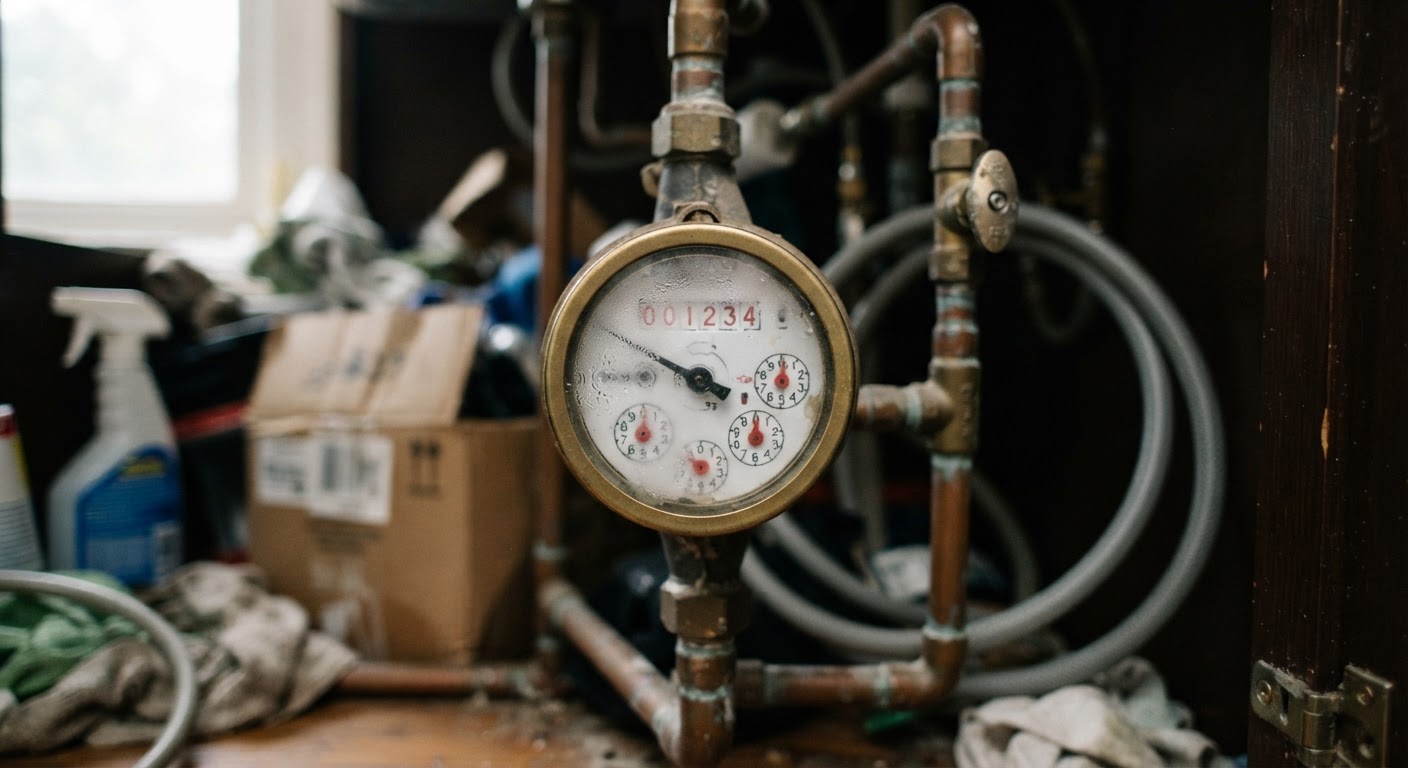
If your bill history looks off, you can confirm a leak yourself without any tools. Make sure no water is running anywhere in the house — no dishwasher, no washing machine, nobody flushing — and go look at your water meter. Most meters have a small leak indicator, sometimes a tiny triangle or star-shaped dial, that spins if any water is flowing through the line. If it’s moving with everything off, water is going somewhere it shouldn’t. Write down the meter number, wait an hour with everything still off, and check it again — any change confirms a leak even if the indicator dial isn’t obvious on your particular meter.
Check the usual suspects first
Before you assume it’s a slab leak or something expensive, rule out the cheap, common causes:
- A toilet flapper that doesn’t seal completely, letting the tank refill constantly
- An outdoor spigot or hose bib that drips when the hose is disconnected
- A water softener or filtration system stuck in a regeneration cycle
- An irrigation zone valve that doesn’t fully close
Toilets are the single most common source of invisible water loss in a home, and the fix is often a five-dollar part, not a plumber’s visit. If your usage history shows a steady climb and you’ve got an older toilet, that’s the first place to look.
How to request an adjustment if something looks wrong
If you’ve gone through your bill, checked the tiers, ruled out obvious leaks, and the number still doesn’t make sense, it’s worth requesting a formal review. Utilities expect these requests and generally have a straightforward process — you’re not asking for a favor, you’re asking them to double-check their own numbers.
Gather your evidence first
Before you call, pull together:
- Your last several bills, so you can point to the specific month usage jumped
- Your own meter readings, if you took them during a leak check
- Notes on anything that changed — a repair, a new appliance, a period away from home
- Photos of the meter reading and its date, if you’re disputing an estimated read
Having this ready shortens the call significantly, because the first thing a representative will usually do is ask what you’ve already checked.
Ask specific questions, not just “why is this so high”
You’ll get a more useful answer if you ask precisely what you want to know:
- “Was this bill based on an actual meter read or an estimate?”
- “Can you confirm the meter reading dates and whether the billing period length changed?”
- “Is there a record of a leak adjustment or high-usage credit policy I might qualify for?”
- “Can someone re-read the meter manually to confirm the number?”
That last question matters — a fair number of billing disputes turn out to be a misread or a transposed digit, and a manual re-read settles it fast.
Ask about leak adjustment policies specifically
Many water utilities have a standing policy — sometimes called a leak adjustment, high-bill adjustment, or similar — that reduces or credits part of a bill when a customer can show a leak was fixed. These policies vary a lot by provider and usually require you to show the repair was completed, sometimes with a receipt or a follow-up reading proving usage dropped back to normal. This isn’t a hardship or emergency program — it’s a routine correction utilities offer because they’d rather retain a paying customer than have one dispute every bill. Ask directly whether your provider has this option and what documentation they need; the answer and the process will be specific to your utility, so treat anything you read online as a starting point for that phone call, not the final word.
Get everything in writing
If you’re told an adjustment will be applied, ask for confirmation by email or through your account portal, along with a timeframe for when you should see the credit. Utility billing systems are large and slow-moving, and a verbal promise on a phone call is easy to lose track of on both ends. A written confirmation gives you something to point back to if the credit doesn’t show up on schedule.
None of this requires special expertise — just a habit of actually reading the bill instead of skimming to the total. Once you know where the tiers sit, what a normal usage range looks like for your household, and how to tell an actual read from an estimate, most billing surprises stop being surprises. And the ones that are genuinely wrong get caught early, before a small error turns into several months of quietly overpaying.